
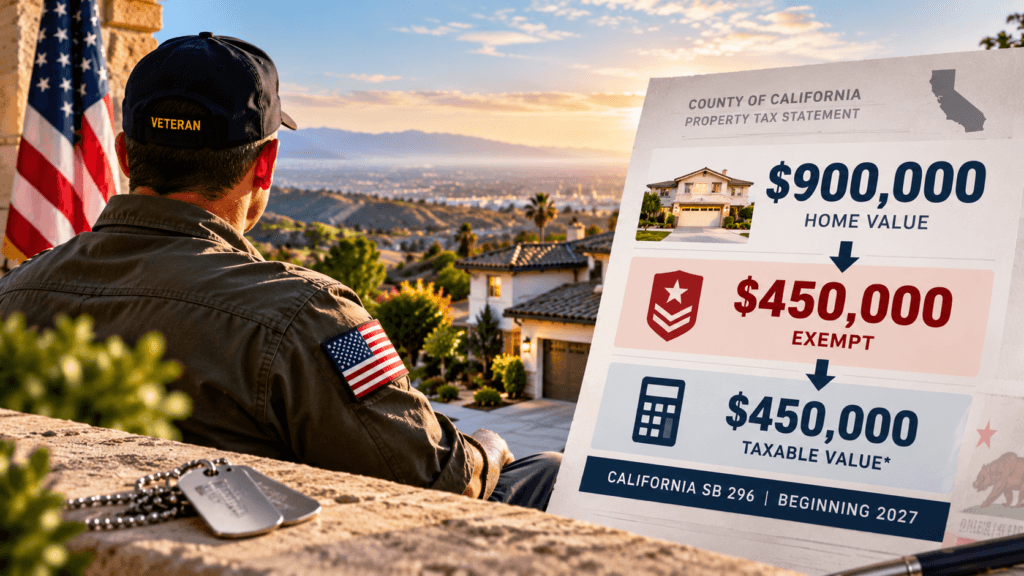
What if a $900,000 California home was only taxed on $450,000 of its value?
For some disabled veterans, that could soon be the reality.
California just passed a major expansion of its Disabled Veterans' Property Tax Exemption, and considering what homes cost today—especially here in Southern California—the potential savings are significant.
Governor Gavin Newsom signed Senate Bill 296 (SB 296) into law on September 28, 2026. Beginning in 2027, qualifying disabled veterans could receive a property tax exemption equal to 50% of the first $1 million of their home's value.
For qualifying lower-income disabled veterans, the benefit could be even greater—up to 100% of the first $1 million in value could potentially be exempt.
Think about that for a minute.
On a $900,000 home, we're not talking about saving a few hundred dollars.
We're potentially talking about thousands of dollars in property taxes every year.
And that's why I think this is important for more than just veterans.
If you're a Realtor working with a veteran, a family member helping one buy a home, or a homeowner who may qualify and simply doesn't know this benefit exists, SB 296 is something worth knowing about.
Here's what changed, who may qualify, and why this could have a meaningful impact on the true cost of owning a home in California.
California Already Has a Disabled Veterans' Property Tax Exemption
SB 296 isn't creating California's Disabled Veterans' Exemption from scratch.
California already allows qualifying disabled veterans and certain surviving spouses to exempt a portion of their home's assessed value from property taxation.
For 2026, the exemption amounts are:
$180,671 for the basic exemption
$271,009 for the low-income exemption
The 2026 household income limit for the low-income exemption is $81,131.
Those are meaningful exemptions.
But with Southern California home values regularly reaching $700,000, $800,000, $900,000 and beyond, SB 296 takes the potential benefit to an entirely different level.
What Changes Under SB 296?
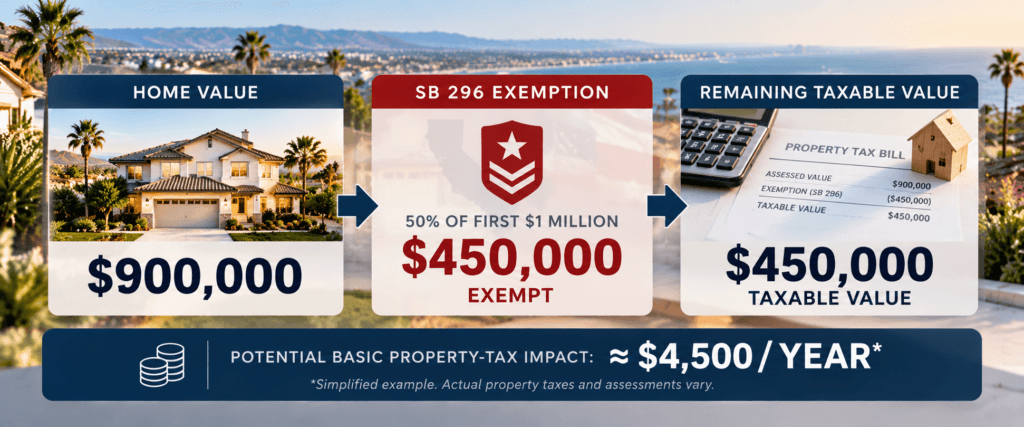
Beginning with property tax lien dates on or after January 1, 2027, a qualifying disabled veteran's principal residence may receive an exemption equal to:
50% of the first $1 million of the property's full value.
Here's what it could look like:
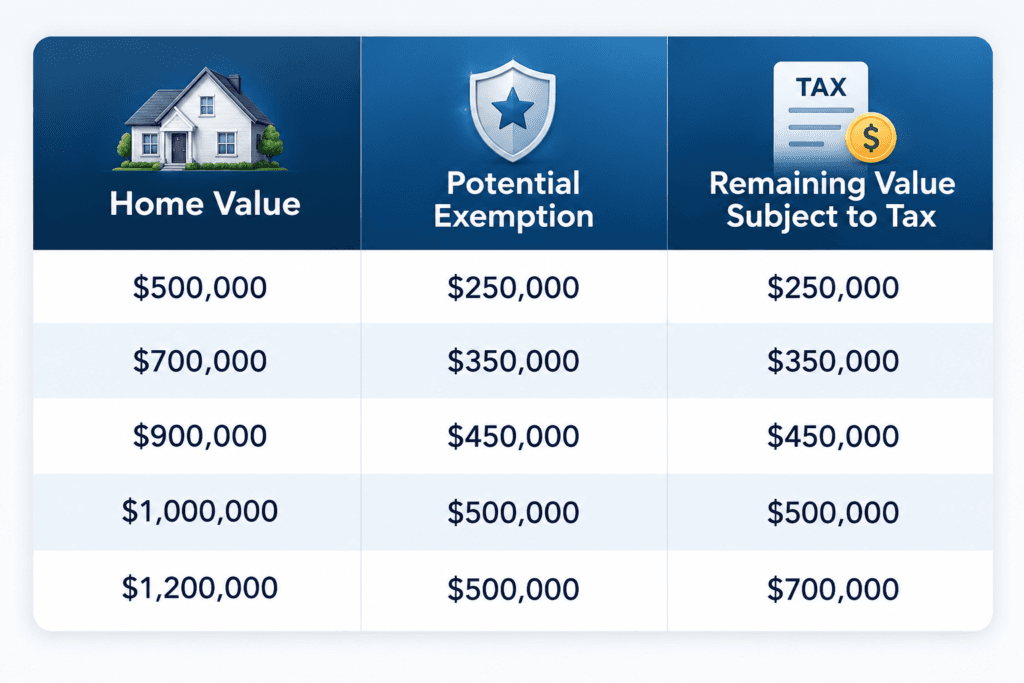
That's where the $900,000 example in the headline comes from.
A qualifying veteran with a $900,000 home could potentially have $450,000 of value exempt from property taxation.
That's a substantial benefit.
For Some Lower-Income Veterans, the Benefit Is Even Bigger
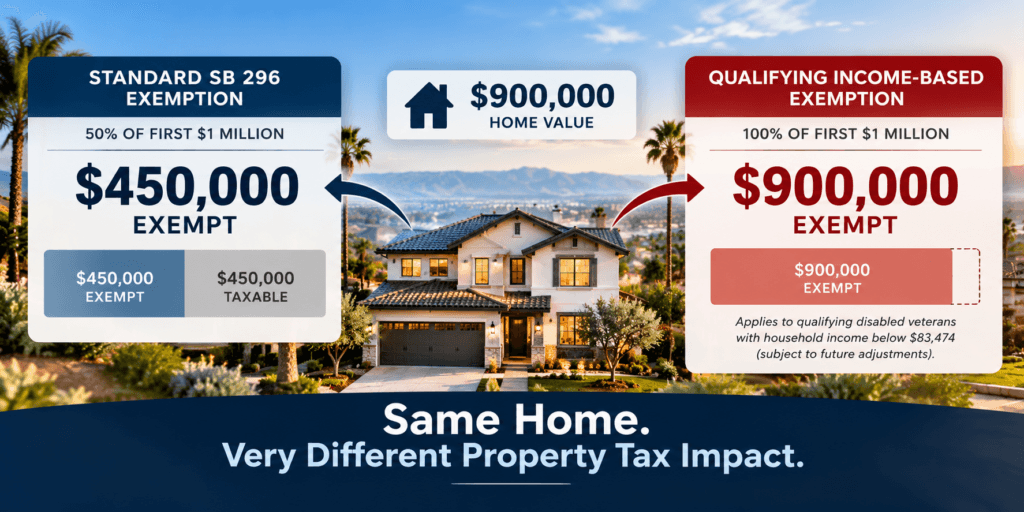
This may be the most significant part of the new law.
SB 296 provides an enhanced exemption for qualifying disabled veterans whose household income falls below the applicable threshold.
Instead of 50% of the first $1 million, the exemption can potentially equal:
100% of the first $1 million of the property's full value.
The legislation initially establishes an income threshold of $83,474, with adjustments provided for future assessment years.
So let's go back to that same $900,000 home.
A veteran qualifying for the standard SB 296 exemption could potentially receive:
$450,000 exempt
A veteran who also qualifies under the applicable income requirement could potentially receive:
$900,000 exempt
That's a very different property tax conversation.
How Much Could That Actually Save?
Let's keep the math simple.Suppose a qualifying veteran owns a home with a full value of $900,000.
Under the 50% exemption:
$900,000 × 50% = $450,000 of exempt value
California's basic property tax rate is generally 1% of assessed value, before voter-approved indebtedness and other charges.
One percent of $450,000 is:
$4,500 per year.
That's roughly $375 per month when you look at it as an annual housing expense.
And for a veteran who qualifies for the enhanced income-based exemption, the potential savings associated with the exempt value could be substantially greater.
Of course, this is a simplified example.
Actual property tax bills can include voter-approved bonds, special assessments and other charges that may not disappear simply because a portion of the property's value is exempt.
But it illustrates why this law matters.
Who Qualifies for the Disabled Veterans' Exemption?
This is important:
SB 296 is not a property tax exemption for every veteran.
The Disabled Veterans' Exemption has specific eligibility requirements.
Generally, the veteran must have a qualifying service-connected disability. This can include a veteran who:
~ Is blind in both eyes as defined under the law;
~ Has lost the use of two or more limbs because of a service-connected injury or disease; or
~ Is considered totally disabled as a result of a service-connected injury or disease.
For purposes of the exemption, "totally disabled" generally includes a veteran rated 100% disabled by the U.S. Department of Veterans Affairs or the applicable military service.
Certain veterans receiving compensation at the 100% level because they are unable to secure or follow substantially gainful employment may also qualify.
The property must also generally be the veteran's principal place of residence.
Eligibility should always be confirmed directly with the County Assessor rather than assumed.
What About Surviving Spouses?
Certain unmarried surviving spouses of qualifying veterans may also be eligible for the Disabled Veterans' Exemption.
There are specific requirements surrounding the veteran's disability or death, the surviving spouse's status, ownership and occupancy of the property, and other factors.
So if you're the surviving spouse of a qualifying veteran, don't assume that the exemption ended when your spouse passed away.
It's worth asking your County Assessor whether you qualify.
When Does the New Exemption Begin?
SB 296 was signed into law on September 28, 2026, but the expanded exemption doesn't begin immediately.
The new provisions apply to qualifying property tax lien dates beginning:
January 1, 2027
The legislation currently applies to lien dates before January 1, 2032.
That means the expanded benefit, as currently written, has a defined period.
That's an important detail to understand, particularly when thinking about this benefit as part of the long-term cost of homeownership.
Realtors Should Know About This Too

This is where I think the new law becomes especially interesting for real estate professionals.
Imagine you're working with a veteran who tells you:
"I'd love to buy a home, but California is just too expensive."
Normally, we immediately start talking about purchase price, interest rates and monthly mortgage payments.
But the cost of homeownership doesn't stop at principal and interest.
There's homeowners insurance.
HOA dues.
Maintenance.
And there's property tax.
For a qualifying disabled veteran, SB 296 could significantly change that last number.
I'm not suggesting Realtors should determine whether someone qualifies for a tax exemption.
They shouldn't.
But there is a very simple question you can ask:
"Have you checked whether you qualify for California's Disabled Veterans' Property Tax Exemption?"
That's it.
You don't have to be the tax expert.
Sometimes providing value simply means knowing enough to point someone toward the right resource.
Buying a Home? There's Another Property Tax Issue to Think About
If you've read some of my other articles, you know I talk a bit about supplemental property tax bills.
They're one of those things that can surprise California homeowners after closing.
When a property changes ownership, the County Assessor generally reassesses it based on the new ownership and value. That can result in one or more supplemental assessments in addition to the regular property tax bill.
The Disabled Veterans' Exemption can also come into play when an eligible veteran acquires a new principal residence.
That's why I wouldn't wait for a supplemental tax bill to show up in the mailbox before asking about the exemption.
If you're buying a home and believe you qualify, contact the County Assessor and ask:
How will it affect a supplemental assessment resulting from my purchase?
Timing matters.
It's much easier to understand what's coming when you're asking these questions before the tax bills arrive.
This Isn't Automatic
There's one more thing homeowners need to understand.
Being a 100% disabled veteran doesn't necessarily mean your property tax bill automatically changes.
A claim needs to be filed with the County Assessor, and documentation establishing eligibility may be required.
That can include documentation from the U.S. Department of Veterans Affairs or the applicable military service establishing the veteran's disability rating.
If you think you may qualify, don't wait until you receive your next property tax bill to start researching it.
Contact your County Assessor and find out what they need.
The Bigger Picture
California housing affordability isn't just about the price of the house.
It's about the total cost of owning it.
Mortgage payment.
Property taxes.
Insurance.
HOA dues.
Utilities.
Maintenance.
All of those numbers matter.
For qualifying disabled veterans and their families, SB 296 could substantially reduce one of those expenses beginning in 2027.
And in a housing market where affordability continues to be one of the biggest challenges buyers face, that's information worth knowing.
One Last Thought
SB 296 is a property tax issue, not a title insurance law. But property taxes, assessments, ownership changes and the costs that follow a real estate transfer are all part of understanding what happens when property changes hands.
Working in title insurance puts me in the middle of property ownership every day. I review title, vesting, property records and issues that can affect a transaction before it closes. Through The AC Current, I also share general educational information about property ownership and the real estate issues homeowners and real estate professionals may encounter before, during and after a transaction.
SB 296 is one of those issues worth understanding.
If you're a qualifying disabled veteran, this exemption could potentially save you thousands of dollars. If you're a Realtor working with veterans, simply knowing that the exemption exists can help you point your client toward the appropriate County Assessor for more information.
Keeping Title Cool. Closing with Confidence.
This article is provided for general educational purposes only and is not intended as legal, tax or financial advice. Eligibility, exemption amounts and the application of property tax exemptions to a particular property are determined under applicable law and by the appropriate County Assessor. Property owners should verify current requirements with their County Assessor and consult qualified tax or legal professionals regarding their individual circumstances.

ABOUT THE AUTHOR
About Adrian Crandall
Senior Sales Executive | Corinthian Title Company
Real estate is full of moving parts—and the best decisions happen when someone helps connect the dots.
For more than 25 years, I’ve helped Southern California Realtors, lenders, escrow professionals, attorneys, investors and homeowners navigate title issues, housing policy, market trends and the hidden details that can delay a closing.
Through The AC Current and my Connecting the Dots series, my goal is to help real estate professionals stay informed, protect their clients and remain one step ahead.
Questions about title, vesting, probate, fraud prevention or a transaction? I’m always happy to be a resource.

Continue Connecting the Dots
More practical insight on title, housing policy, fraud prevention and Southern California real estate.



Stay Ahead of Southern California Real Estate
Each month, The AC Current delivers practical insight on market conditions, title issues, housing policy, fraud prevention, property taxes, probate and trust transactions.
Get The AC Current