

Most Realtors don't have a lead problem. They have a targeting problem.
The problem with traditional real estate prospecting is that too often we start with a giant list of homeowners instead of asking who might actually be worth talking to.
If your prospecting list is simply “homeowners in this ZIP code,” you're spending time, money and energy talking to hundreds—or thousands—of people who may have no particular reason to move.
Meanwhile, somewhere in that same list is a homeowner who has lived in a four-bedroom house for 18 years, has substantial equity, and may be starting to wonder whether that house still fits the next chapter of their life.
There's an absentee owner who's had a rental property for 12 years.
There's a homeowner three doors down from your new listing who has been in the neighborhood since 2004.
There's a family trying to figure out what to do with an inherited property.
Those aren't necessarily sellers.
They're signals.
And I think that's one of the biggest distinctions Realtors can make when it comes to prospecting:
"Don't look for more leads. Look for better signals."
The goal isn't to predict who will sell. It's to identify homeowners where there may be a legitimate reason for a real estate conversation—and then give them a good reason to talk to you.
The problem isn't your database. It's how you're looking at it.
Imagine I gave you two prospecting lists.
List A: 2,000 homeowners in your target ZIP code.
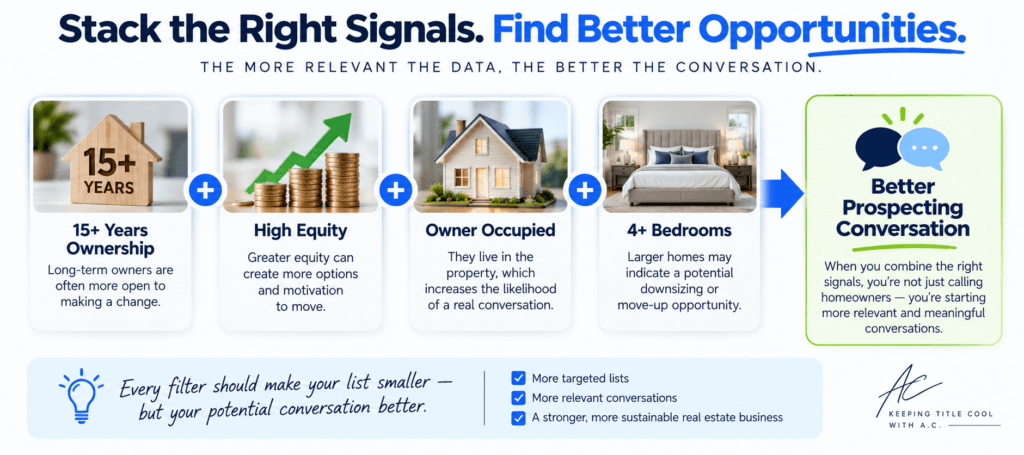
List B: 47 homeowners who: have owned their home for 15+ years, have substantial estimated equity, occupy the property as their primary residence, own a larger home, and aren't currently listed for sale.
Which list would you rather call?
I'd take the 47.
Not because I know they're selling. I don't.
I'd take them because I can think about why a conversation with them might be relevant.
That's what I call stacking signals.
High equity alone doesn't tell you much.
Long-term ownership alone doesn't tell you much.
A four-bedroom house alone doesn't tell you much.
But put those things together and suddenly you have a possible story:
Long-term homeowner + substantial equity + larger home + life-stage indicators = someone who may benefit from understanding what their equity could make possible.
Now you have something useful to talk about.
That's very different from:
“Hi, I'm a local Realtor. Are you thinking about selling?”
Start with the data you may already have access to
This is where I think a lot of Realtors unnecessarily spend money.
Before buying another subscription, lead service or shiny new app, find out what resources are already available to you through your title company, brokerage, MLS and other relationships.
At Corinthian Title Company, for example, I can provide my Realtor clients access to tools that can help build these kinds of targeted prospecting campaigns.
One of them is TitlePro247.
TitlePro247 provides property and ownership information, and through our program we have additional mortgage and demographic search capabilities that can help narrow a large group of homeowners into a much more focused audience.
But here's the important part:
Having more filters isn't the strategy. Knowing which filters to combine is.
Instead of asking me:
“Can you give me a list of high-equity homeowners?”
I'd rather have you say:
“Adrian, I want to find homeowners in Yorba Linda who have been there at least 15 years, have substantial equity, live in the property, and own homes with at least four bedrooms.”
Now we're building a prospecting strategy instead of just buying names.
Every filter should make your list smaller—and your potential conversation better
Here's another example.
Suppose you want more investor business.
We could pull absentee owners.
But that's still a pretty broad audience.
So let's keep going.
Absentee owner + 10+ years ownership + substantial equity + residential investment property + owner lives outside the immediate area.
That's more interesting.
Now a Realtor could approach the owner with something useful:
“I work with several property owners who own rentals in this area but live elsewhere. If it's helpful, I can put together an updated value and a quick hold-versus-sell analysis so you can see how the property fits your investment plans today.”
You're not assuming they want to sell.
You're giving them information that helps them make a decision.
And that's the difference.
A Better Approach to Real Estate Prospecting
Property data can help answer who might be worth talking to.
But sometimes another piece of information helps answer why now?
That's where another resource we provide, Corinthian TitleToolBox, can become useful.
TitleToolBox can help identify certain property and life-event situations, including opportunities involving:
These can be powerful prospecting signals—but they need to be handled very differently from a normal farming list.
Because there's something Realtors need to remember:
A difficult life event isn't permission to become more aggressive. It's a reason to become more useful.
If someone is dealing with probate, divorce or financial trouble, the last thing they need is a Realtor calling them and saying, “I saw your foreclosure.”
That's not prospecting.
That's a great way to make somebody never want to hear from you again.
Instead, think about the real estate problem that may accompany the situation.
A family dealing with an inherited property may need help understanding value, title, repairs, clean-out options or how to sell a property when family members live out of the area.
A landlord who has just gone through an eviction may be deciding whether to re-rent the property or sell it.
A homeowner facing financial pressure may first need to understand what the home is worth and how much equity may be available before they can make an informed decision.
Your job isn't to exploit the event.
Your job is to be the knowledgeable person who can help when a real estate question emerges from it.
If you're working with inherited property owners in particular, this is also where good title knowledge becomes valuable.

One of my favorite strategies doesn't require a life event at all
Let's say you just listed a house.
Most Realtors market the listing to potential buyers.
Of course you should.
But there's another audience sitting right around the property:
the neighbors.
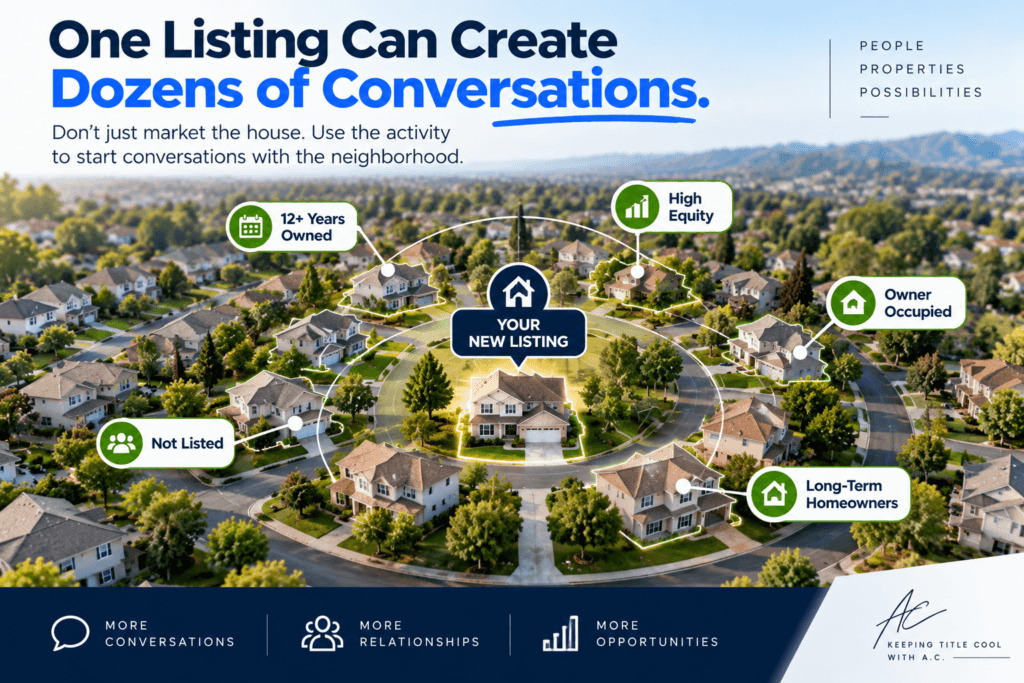
Your listing just created a perfectly legitimate reason to contact them.
Instead of circle prospecting every house indiscriminately, however, use data to prioritize the people around the listing.
Take the surrounding neighborhood and identify:
long-term owners + higher equity + owner occupants + not currently listed.
Now your new listing becomes a prospecting event.
Your conversation doesn't have to start with:
“Do you want to sell?”
It can start with:
“I just listed the home around the corner from you on Oak Street. Since you've been in the neighborhood for a while, I thought you might be interested in seeing where we positioned it and what we're seeing from buyers.”
That's a natural conversation.
And when the property sells?
You have another reason to contact them.
This “circle marketing” approach uses listing and sales activity as a reason to engage nearby homeowners, adding filters to refine the audience further.
TRY THIS WITH YOUR NEXT LISTING
One listing. 25 homeowners. Three legitimate reasons to communicate.
Stop asking, “Who can I call?” Start asking, “Why am I calling?”
This may be the most important idea in this entire article.
There are dozens of homeowner groups Realtors can identify:
long-term owners, absentee owners, high-equity homeowners, landlords, inherited properties, vacant properties, potential downsizers, homeowners approaching ownership anniversaries, homeowners surrounding a recent listing or sale, and many others.
The data isn't the hard part anymore.
The conversation is.
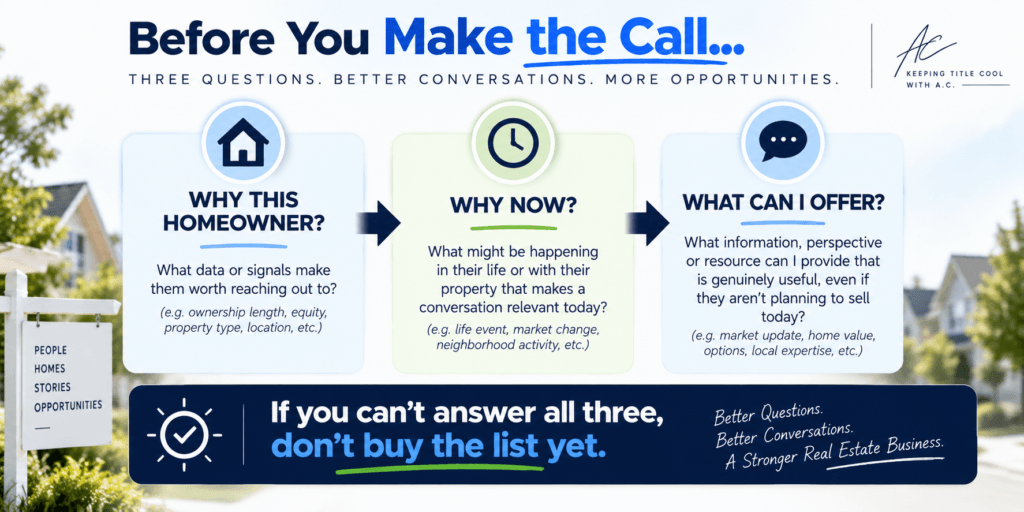
Before you ever generate a list, I want you to be able to answer three questions:
Why this homeowner? Why now? What can I offer them that's actually useful?
If you can't answer those questions, don't buy the list yet.
Buying the list isn't prospecting
This is where even good lead-generation programs often fail.
A Realtor gets excited about an idea.
They download 200 names.
They call 25.
Nobody immediately says, “I've been waiting for a Realtor to call me!”
And the spreadsheet quietly disappears into a folder on their computer.
The problem usually isn't the list.
It's the lack of a repeatable system behind it.
Prospecting works best when you decide in advance who you're targeting, why the conversation might matter, how you're going to reach them, and what you're going to do if they don't respond the first time.
Because most people aren't going to respond on the first attempt.
That doesn't mean sending “Just following up…” five times.
It means creating multiple reasons for someone to remember you.
The exact sequence matters less than the consistency—and whether each contact gives the homeowner something useful.
The best prospecting campaigns aren't built around one perfect phone call.
They're built around relevant, consistent follow-up.
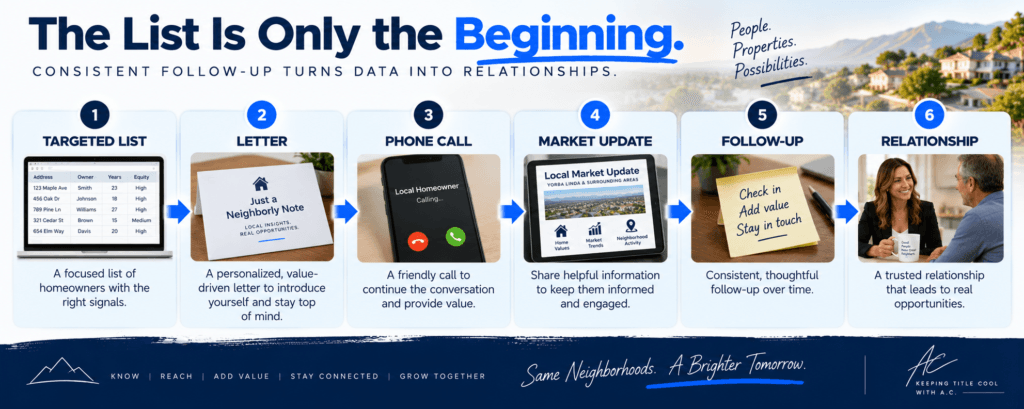
A simple 30-day prospecting sequence might look like:
Day 1: Personal introduction + useful reason for reaching out
Day 7: Property/neighborhood information
Day 14: Phone call or personal text
Day 30: Relevant market update or property valuation
Ongoing: Contact only when you have something worth saying
The sequence isn't the magic. Relevance is. Every contact should answer the homeowner's unspoken question: Why is this worth my attention?
Think short-term opportunity and long-term relationships
Not every prospecting campaign should have the same timeline.
Some situations may create a more immediate real estate need.
A probate.
A pre-foreclosure.
A vacant property.
A landlord deciding whether to keep or sell a rental.
Those situations can sometimes create conversations that matter today.
But other prospecting is about building recognition over time.
Your neighborhood farm.
Long-term homeowners.
Homeownership anniversaries.
Circle prospecting around your listings and sales.
Those homeowners may not need you this month—or even this year.
That doesn't make the relationship less valuable.
It just means you're playing a longer game.
I like to think about it this way:
Prospect for today. Build relationships for tomorrow.
A strong Realtor business needs both.
You want enough focused prospecting to create opportunities now, while consistently building relationships with homeowners who may eventually become clients, referral sources or advocates for your business.
Start small enough that you'll actually work the list
This is one of the biggest mistakes I see with prospecting technology.
People assume bigger is better.
If 50 leads are good, 500 must be better.
If 500 are good, 5,000 must be amazing.
But if you aren't going to consistently work the first 50, the other 4,950 aren't helping you.
They're just sitting in a database.
I'd much rather see a Realtor start with 25 or 50 carefully selected homeowners and actually work the campaign.
Your First Prospecting Campaign Should Probably Be Smaller Than You Think
Figure out the signal.
Develop the conversation.
Make the calls.
Send the information.
Follow up.
Track what happens.
Then improve it and expand.
That's also why I like starting with resources such as TitlePro247 and TitleToolBox.
Through Corinthian Title, we can often build or purchase a smaller, more focused group instead of immediately committing to another large monthly lead-generation expense.
That gives you a chance to answer a much more important question first:
Will I actually work this strategy consistently?
If the answer is yes, then it may make sense to scale.
Where a more advanced platform can fit
Once you've proven that you're going to consistently work a prospecting system, more advanced platforms can become extremely valuable.
One example is PropertyRadar.
PropertyRadar offers a much deeper level of property and ownership filtering, list monitoring, contact information and marketing automation.
For a Realtor who is running multiple campaigns, tracking several prospecting audiences and consistently following up, a platform like that can make the process much easier to manage and scale.
But I wouldn't tell every Realtor to start there.
Why?
Because better software doesn't fix inconsistent prospecting.
Technology should amplify a process that's already working.
It shouldn't become another monthly subscription you're paying for while telling yourself you'll get around to using it next week.
Use the lightest tool that allows you to execute the strategy consistently.
Then scale your technology when your prospecting has earned the need for it.
The prospecting formula I want Realtors to remember
Whether you're using TitlePro247, TitleToolBox, PropertyRadar, your MLS, your CRM or a spreadsheet, the technology is secondary.
The strategy is:
SIGNAL → STORY → CONVERSATION → FOLLOW-UP → OPPORTUNITY
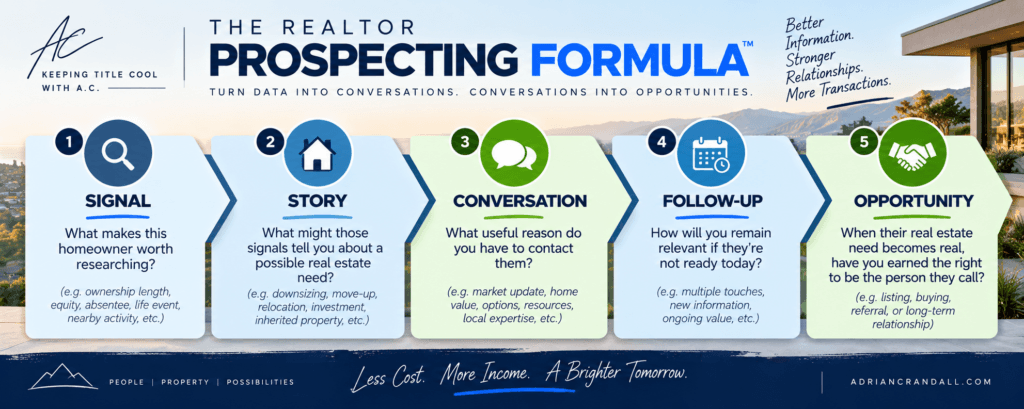
Signal: What makes this homeowner worth researching?
Maybe it's long-term ownership, substantial equity, absentee ownership, a nearby listing, a vacant property or another property-related change.
Story: What might those signals tell you about a possible real estate need?
Not what you assume is happening.
What might reasonably be worth understanding?
Conversation: What useful reason do you have to contact them?
What information, perspective or resource can you provide that makes the conversation worthwhile even if they aren't planning to sell?
Follow-Up: How will you remain relevant if they're not ready today?
What can you continue to provide that keeps the relationship alive without becoming annoying?
Opportunity: When their real estate need eventually becomes real, have you earned the right to be the person they call?
Notice what's missing from that formula: “Buy more leads.”
Because the lead isn't the business.
The relationship is.
Before you spend another dollar on leads, let's see what you already have
If you're a Realtor and you've been thinking,
I know I should prospect more, but I don't even know who I should be calling,
that's something I can help with.
You don't need to start with thousands of homeowners.
Start by answering two questions:
What type of homeowner would you like to work with?
and
What market do you want more business in?
We'll start there.
Through the resources available to my Realtor clients at Corinthian Title, I can help you look at the property data, mortgage information, demographic filters and opportunity-based leads that may already be available to you.
Then we'll narrow the audience.
We'll look for the signals.
We'll think about what the homeowner might actually find useful.
And we'll build something small enough that you'll realistically work it.
Because the goal isn't to give you another list.
It's to help you create more conversations.
And conversations are where the business actually starts.
Tell me the type of homeowner you want to reach and the market where you want to grow your business. I'll help you figure out where to start.

ABOUT THE AUTHOR
About Adrian Crandall
Senior Sales Executive | Corinthian Title Company
Real estate is full of moving parts—and the best decisions happen when someone helps connect the dots.
For more than 25 years, I’ve helped Southern California Realtors, lenders, escrow professionals, attorneys, investors and homeowners navigate title issues, housing policy, market trends and the hidden details that can delay a closing.
Through The AC Current and my Connecting the Dots series, my goal is to help real estate professionals stay informed, protect their clients and remain one step ahead.
Questions about title, vesting, probate, fraud prevention or a transaction? I’m always happy to be a resource.

Continue Connecting the Dots
More practical insight on title, housing policy, fraud prevention and Southern California real estate.



Stay Ahead of Southern California Real Estate
Each month, The AC Current delivers practical insight on market conditions, title issues, housing policy, fraud prevention, property taxes, probate and trust transactions.
Get The AC Current