

Over the last several years I've noticed something surprising.
More than half of the California inherited property transactions I work on today involve trusts, probate, or families navigating the loss of a loved one.
Growing families.
Empty nesters.
Job transfers.
People looking for a bigger home.
People downsizing.
Those transactions still happen.
But lately, I've noticed something different.
When I look back at the files I've been working on, more than half involve a death in the family, an inherited property, a trust administration, or probate.
That wasn't always the case.
For years, I've spent a lot of time working alongside the Orange County Public Administrator's Office, helping with probate files. At the time, probate felt like a specialty. It was something I handled more often than many title professionals, but it certainly wasn't the majority of my business.
Today?
It feels like this is where the market is headed.
I don't think that's a temporary shift.
I think we're watching one of the biggest changes in California real estate happen right in front of us.
The next wave of listings isn't just going to come from homeowners deciding to move.
This observation also explains something I've been talking about in my article, The Quietest Market Most People Don't Notice.
While many people focus on home prices or interest rates, I pay close attention to recording activity because it often reveals where the next opportunities are developing long before they become obvious.
It's going to come from life's biggest transitions.
California Is About to Experience One of the Largest Transfers of Real Estate in History
Baby Boomers own a tremendous amount of California real estate.
Many purchased their homes decades ago, raised their families there, and watched those homes appreciate dramatically over time.
Now those homes are beginning to change hands.
Not because the owners decided to sell......but because life happened.
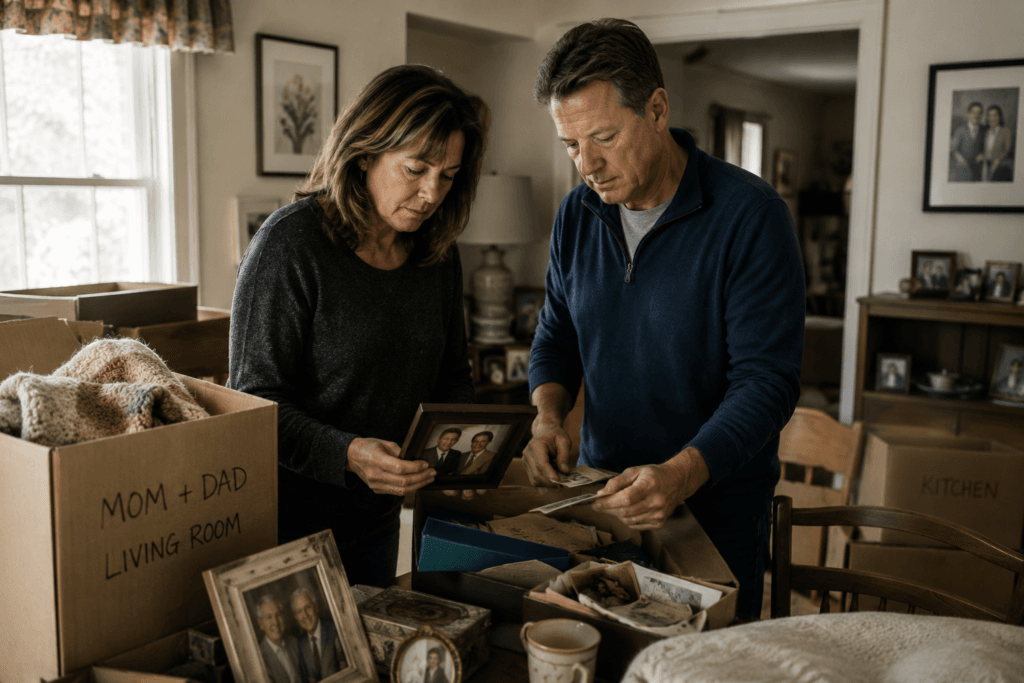
Children are inheriting homes.
Successor trustees are stepping into responsibilities they never expected.
Families are trying to navigate probate while grieving the loss of someone they love.
For many Realtors, these aren't the transactions they learned about when they first got licensed.
They're becoming some of the most important transactions they'll ever handle.
Why Inherited Property Sales Become Complicated
One of the first phone calls I often receive sounds something like this:
"The daughter is selling her mother's home."
Maybe.
Maybe not.
One of the biggest surprises in inherited property transactions is discovering that the person everyone expected to have authority to sell... doesn't.
Sometimes the property is still owned individually.
Sometimes it was transferred into a trust.
Sometimes there are multiple owners.
Sometimes there are heirs no one anticipated.
Sometimes probate is required.
Sometimes it isn't.
If probate does become necessary, the timeline and requirements depend on the specific circumstances of the estate. The California Courts Probate Self-Help Guide provides an excellent overview of the probate process, common timelines, and what families can generally expect.
That's why one of the first things I tell Realtors is:
Don't assume.
Verify.
That's one reason I encourage Realtors to verify ownership before making promises to sellers.
Understanding how property is currently vested—and whether probate or trust administration may be involved—can prevent unnecessary surprises later.
The California Courts website also provides a helpful overview of when probate may be required and the role the court plays in authorizing certain sales.
A five-minute title conversation early can prevent weeks—or months—of surprises later.
The Journey From Homeowner to Closing Isn't Always Straight
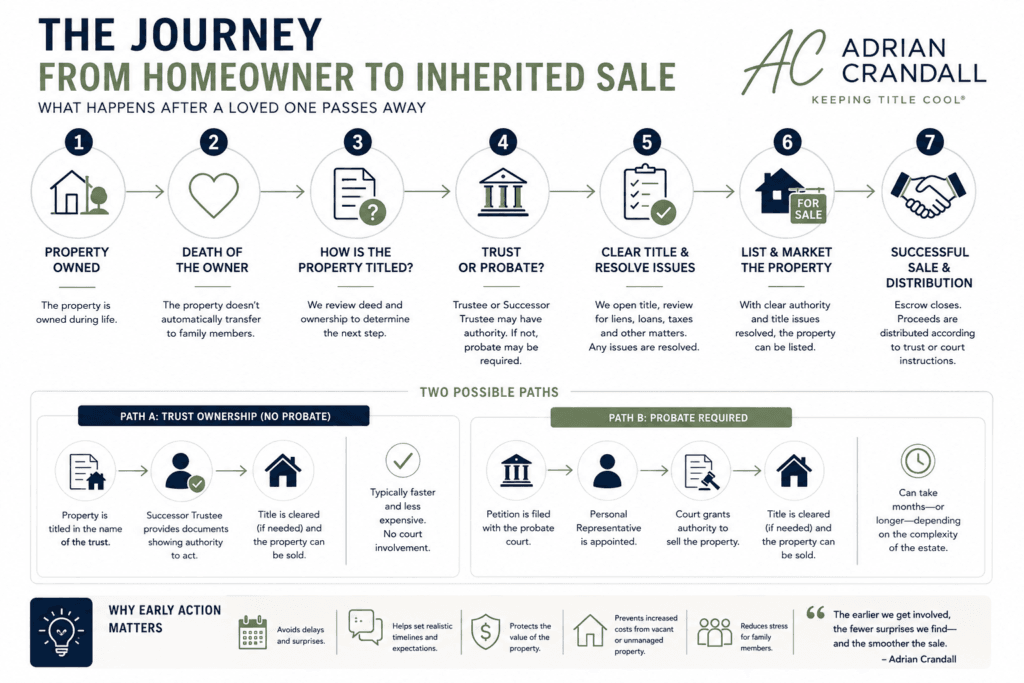
Every inherited property follows a path.
Sometimes it's straightforward.
Sometimes it takes unexpected turns.
Authority has to be established.
Title has to be reviewed.
Issues have to be identified.
Only then can the property move confidently toward the market.
The earlier everyone understands where they are in that journey, the smoother the transaction usually becomes.

The Most Misunderstood Part of Inherited Property
If I had to pick one topic that causes the most confusion, it would be vesting.
People hear that word all the time.
Very few people truly understand why it matters.
One of the most common questions I hear is:
"Dad passed away. Doesn't Mom automatically own everything now?"
Sometimes.
Sometimes not.
It all depends on how title was held before the owner passed away.
A property owned as Community Property with Right of Survivorship is very different from one owned as Tenants in Common.
One may avoid probate.
The other may require it.
The difference isn't what the family hoped would happen.
The difference is how ownership was legally established years earlier.
Why Vesting Matters
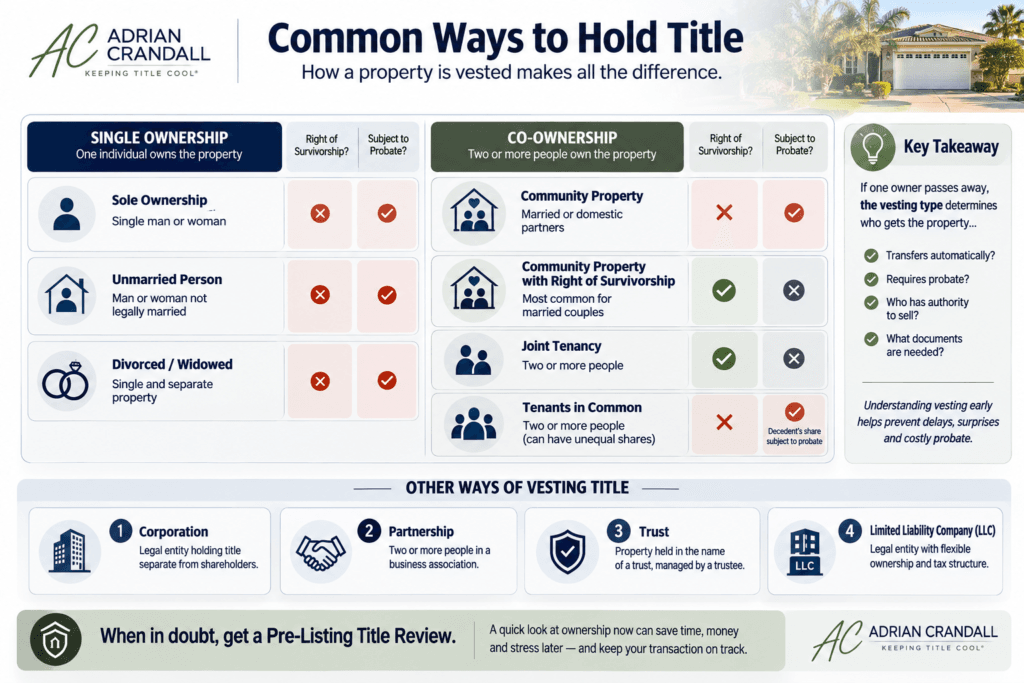
This is one of those topics that seems technical until it suddenly becomes personal.
A simple difference in vesting can determine:
That's why I encourage Realtors to review ownership before making assumptions.
It's much easier to solve questions before the listing goes live than after buyers are waiting for answers.
Not sure how your property is currently vested?
I can usually determine that in just a few minutes.
Contact Adrian or request a Pre-Listing Title Review before assumptions turn into expensive surprises.
Why Having a Trust Doesn't Always Avoid Probate
This might be the biggest misconception I encounter.
A family will tell me,
"We're okay. Mom had a trust."
My next question is usually,
"Was the property ever transferred into the trust?"
There's often a long pause.
Creating a trust is only part of the process.
The trust has to be funded.
Under California law, a trust is generally created when property is transferred into it or otherwise properly declared as trust property.
Simply signing trust documents doesn't automatically place a home into the trust.
If you're interested in the legal framework behind California trusts, you can review the California Probate Code – Trust Law
That means the property has to be transferred into the trust while the owner is alive.
If that never happened, the property may still require probate even though perfectly good trust documents exist.
Families are understandably surprised.
They thought they had done everything right.
Unfortunately, paperwork sitting in a binder doesn't automatically change ownership.
Every family's situation is different.
Some properties transfer smoothly through a trust, while others require probate before authority to sell can be established.
If you're trying to understand which process applies to your situation, I've put together a more detailed guide explaining Probate & Trust Transfers and what families should expect before listing a property.
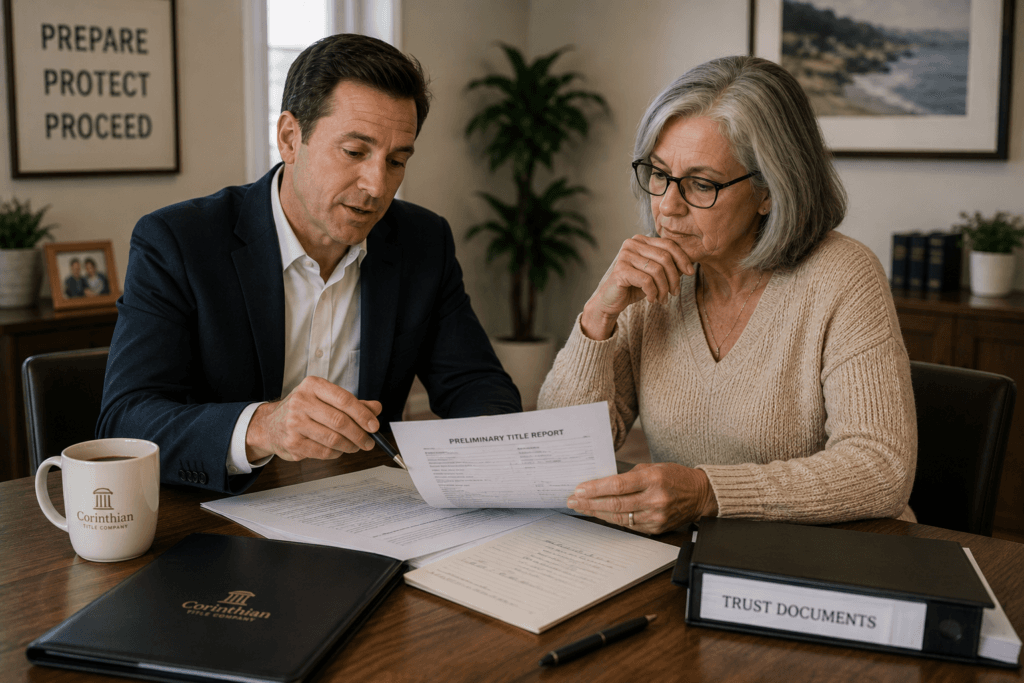
A Real Probate Story: Why Early Title Review Matters
Most title stories end quietly.
This one didn't.
Years ago I worked on a probate where we discovered an old private loan secured against the property.
Before we could close, we needed to locate the lender.
Nobody knew where they were.
Eventually, after quite a bit of detective work, we found them.
When we called and explained we had money waiting for them, they thought it was a scam.
It wasn't.
They received nearly $100,000 they had completely written off years earlier.
Those are the moments people don't see.
Title isn't just paperwork.
Sometimes it's reconnecting people with decisions made decades ago.
Why Successful Realtors Involve Title Early
The Realtors who handle inherited property most successfully all have one thing in common.
They involve Title before the property ever hits the market.
A quick ownership review often uncovers vesting questions, unreleased loans, trust issues, or probate concerns while there's still time to solve them without delaying a closing.
That's exactly why I recommend starting with a Pre-Listing Title Review.
It gives everyone a clearer roadmap before marketing begins.
They don't wait until the listing is active.
They don't wait until escrow.
They don't wait until buyers are writing offers.
They ask questions before they need answers.
They'll call me and say,
"Adrian, here's what we know. What concerns you?"
That's my favorite phone call.
Because most title problems aren't difficult to solve.
They're difficult to solve at the last minute.
Being proactive doesn't eliminate every surprise.
Sometimes something gets recorded against the seller during escrow.
Sometimes circumstances change.
But proactive title work eliminates most preventable delays.
If You've Recently Inherited a Home...
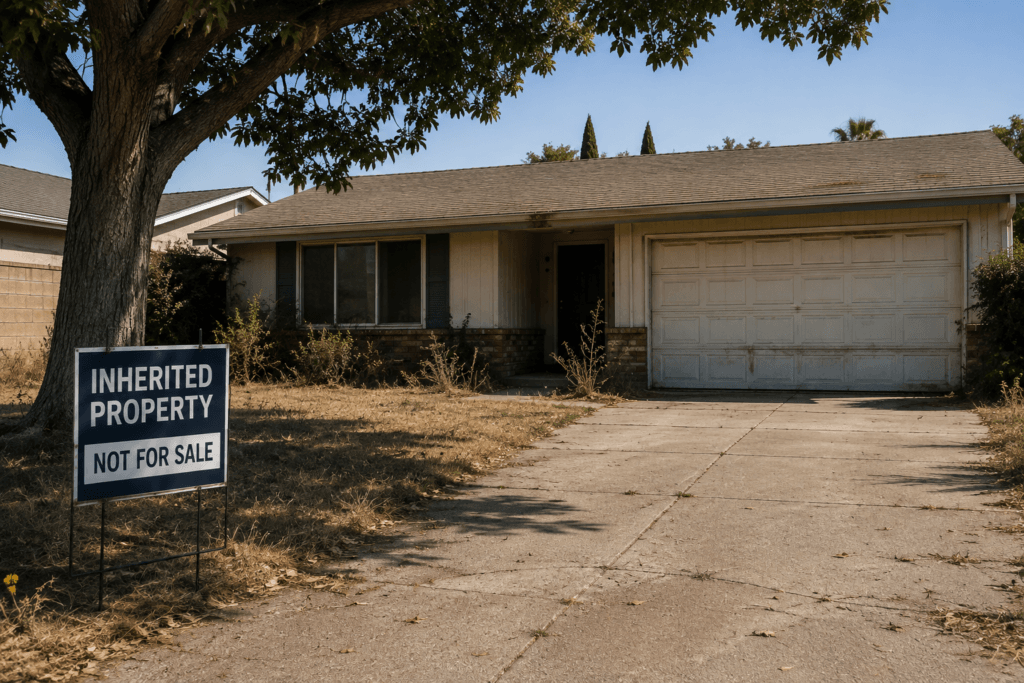
This is the advice I give almost everyone.
Don't do nothing.
Vacant inherited homes are also becoming attractive targets for criminals.
In recent years we've seen an increase in seller impersonation fraud involving vacant and free-and-clear properties.
If you're responsible for an inherited home that's sitting empty, take a few minutes to read my Fraud Watch article.
It explains the warning signs every homeowner and Realtor should know before someone else tries to profit from your property.
I watched this happen during the foreclosure crisis.
People waited.
They hoped things would somehow work themselves out.
Unfortunately, real estate rarely rewards waiting.
Inherited homes sitting vacant become expensive very quickly.
Insurance changes.
Maintenance gets deferred.
Yards deteriorate.
Fraudsters notice.
Small repairs become major repairs.
Whether your plan is to keep the property, rent it, or sell it, taking action early usually protects both the home and the inheritance.
Selling isn't always the best answer.
Some families decide to keep an inherited home as a long-term investment or generate rental income by adding an Accessory Dwelling Unit (ADU).
If that's something you're considering, you may enjoy reading The Backyard Revolution, where I discuss how ADUs are creating new opportunities for California homeowners and investors.
Waiting rarely makes the situation easier.
The Opportunity I See Over the Next Five Years
People often ask me where I think the market is going.
I don't have a crystal ball.
But I do know what I'm seeing every day.
I believe one of the biggest opportunities over the next five years won't be chasing the next first-time homebuyer.
It will be helping homeowners in their 60s and 70s—and eventually their families—prepare for what's next.
Helping them understand how title is currently held.
Helping them avoid unnecessary probate when appropriate.
Helping them identify issues while they still have the ability to make decisions.
Because once someone passes away, Title has to work with the legal record that already exists.
We can't rewrite history.
We can't guess what someone intended.
We can't simply record documents because that's what the family wishes had happened.
We have to honor the ownership as it existed when that person's life ended.
Planning ahead gives families more options.
Waiting usually gives them fewer.
One Final Thought
The market hasn't disappeared.
It's changing.
The professionals who succeed over the next decade won't simply be the ones who know how to market listings.
They'll be the ones who understand where those listings are coming from.
The California Association of Realtors regularly publishes housing research and market data that reinforce how demographics and changing homeowner needs are reshaping today's market.
Staying informed about these trends helps Realtors better serve families navigating inheritance, trust administration, and probate.
I encourage every California Realtor to explore the market research available through the California Association of REALTORS®
For me, this isn't just about title insurance.
It's about helping families navigate one of the biggest transitions of their lives with fewer surprises, better planning, and a smoother path forward.
If you're a Realtor preparing to list an inherited property—or a homeowner wondering what your options are—I'd much rather answer your questions before they become closing delays.
Frequently Asked Questions

ABOUT THE AUTHOR
About Adrian Crandall
Senior Sales Executive | Corinthian Title Company
Real estate is full of moving parts—and the best decisions happen when someone helps connect the dots.
For more than 25 years, I’ve helped Southern California Realtors, lenders, escrow professionals, attorneys, investors and homeowners navigate title issues, housing policy, market trends and the hidden details that can delay a closing.
Through The AC Current and my Connecting the Dots series, my goal is to help real estate professionals stay informed, protect their clients and remain one step ahead.
Questions about title, vesting, probate, fraud prevention or a transaction? I’m always happy to be a resource.

Continue Connecting the Dots
More practical insight on title, housing policy, fraud prevention and Southern California real estate.



Stay Ahead of Southern California Real Estate
Each month, The AC Current delivers practical insight on market conditions, title issues, housing policy, fraud prevention, property taxes, probate and trust transactions.
Get The AC Current