

A California family was about to buy their next home—and potentially leave thousands of dollars in property-tax savings on the table.
The surprising part?
They already knew about Proposition 19.
They simply hadn't thought about how it applied to their move.
That's something I see happen in real estate all the time. Buyers and sellers are dealing with financing, inspections, escrow, moving, title, insurance, deadlines and a hundred other details. Sometimes an opportunity that could save a substantial amount of money is sitting right in front of them.
That's exactly what happened recently with a family I was helping.
And it's a great example of why California homeowners—especially those age 55 and older—should understand how Proposition 19 works before deciding how to structure their next purchase.
What Is California Proposition 19?
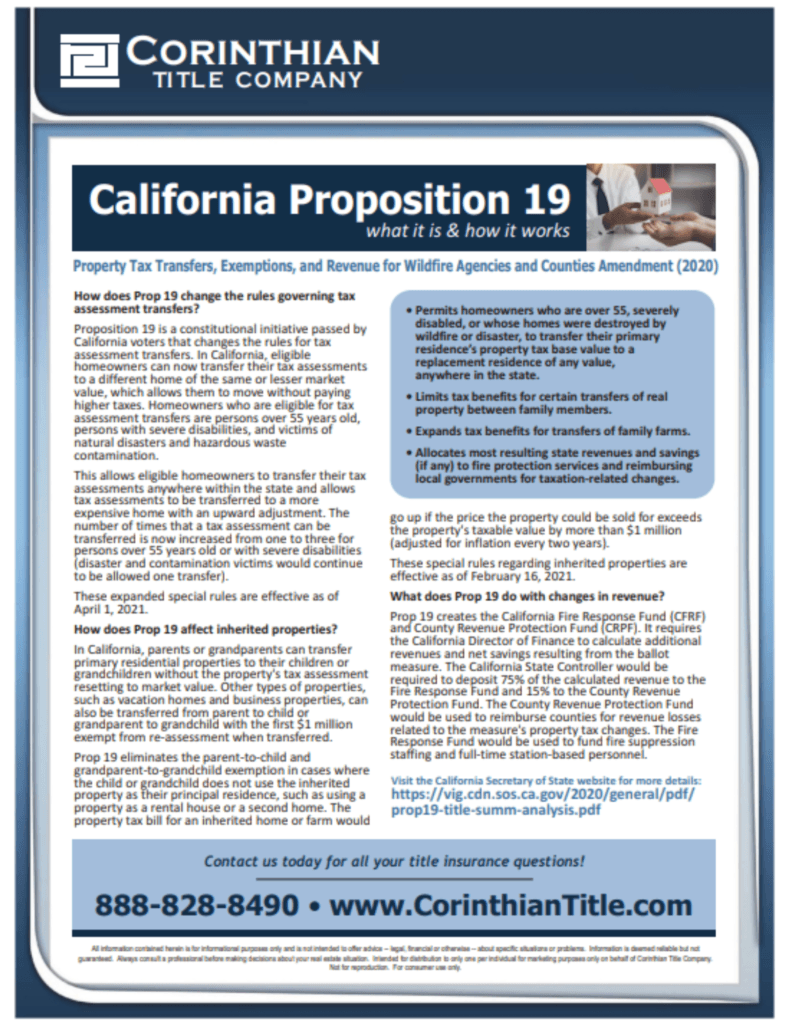
Proposition 19 allows certain California homeowners to transfer the taxable value of their existing primary residence to a replacement primary residence anywhere in California.
The California State Board of Equalization provides detailed Proposition 19 guidance, including eligibility requirements, frequently asked questions and information about both replacement-home transfers and inherited-property provisions.
For the base-year-value transfer discussed in this article, qualifying homeowners generally include:
For someone who has owned a California home for many years, the difference between their current taxable value and the purchase price of their next home can be significant.
That can make Proposition 19 extremely valuable.
But there's an important point:
Proposition 19 covers more than the replacement-home rules we're focusing on here.
The law also made significant changes to parent-child and certain grandparent-grandchild property transfers, family homes and farms, and property-tax treatment following qualifying disasters.
If you're dealing with a home after the death of a parent, my California Inherited Property Guide covers many of the other title and real estate issues families should consider.
For this article, we're concentrating primarily on one part of Proposition 19: transferring the property-tax base of a primary residence to another primary residence.
A Real-Life Proposition 19 Example
Here's what happened recently.
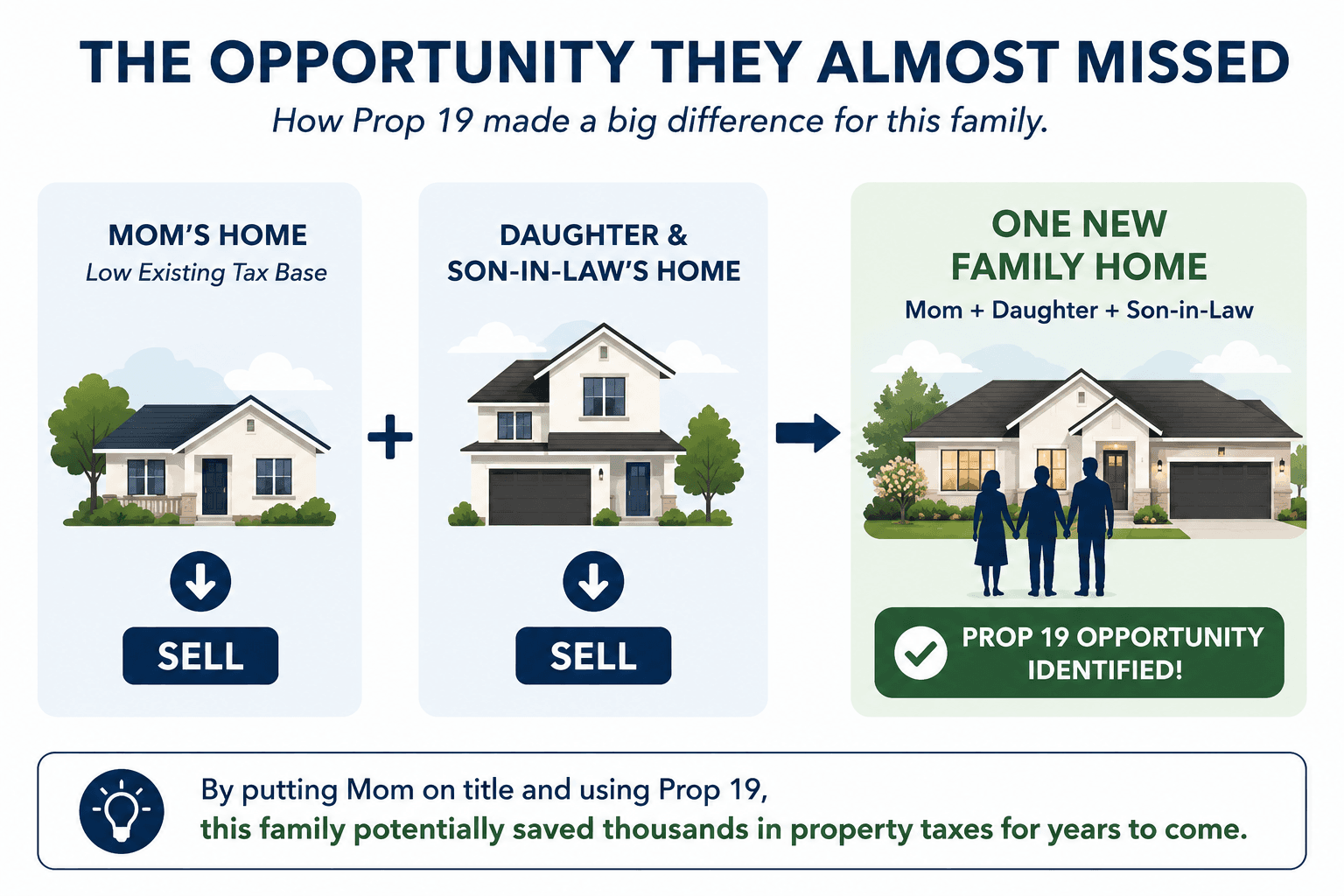
A mother owned her own home.
Her adult daughter and son-in-law owned another home.
Their plan was to sell both properties and combine households by purchasing one new home together, where Mom would live with her daughter and son-in-law.
There was just one detail that caught my attention.
They weren't planning to put Mom on title to the new property.
I was handling title on Mom's sale, but I wasn't even the title provider handling their new purchase.
As I was discussing the situation with their Realtor, I realized something:
Had they considered transferring Mom's property-tax base under Proposition 19?
Mom was over 55. She was selling her principal residence. The new home was going to become her principal residence.
That meant there was a potential Proposition 19 opportunity worth exploring.
But for Mom to claim the age-55 base-year-value transfer, she needed to own and occupy the replacement property as her principal residence when making the claim.
That made the way they structured ownership of the new home important.
Fortunately, putting Mom on title worked with the family's plans.
And addressing that issue before everything was completed could potentially save the family thousands of dollars in property taxes going forward.
Here's the Crazy Part: They Already Knew About Proposition 19
When we brought it up, this wasn't some law they'd never heard of.
They knew about Proposition 19.
They even knew some of the details.
They simply hadn't connected the law to the transaction they were in the middle of.
And I think there's a valuable lesson there.
Knowing something and remembering to apply it at exactly the right moment are two very different things.
Real estate transactions can get complicated quickly.
Sometimes you're so focused on getting the loan approved, selling the old house, negotiating the purchase, scheduling movers and getting everything closed that you don't stop to ask:
"Is there anything else we should be considering?"
That's where having experienced people around you can really matter.
It's also one reason I encourage Realtors and sellers to look at title issues before a property goes on the market, rather than waiting until escrow to discover something that could affect the transaction.
Who Qualifies for a Proposition 19 Property-Tax Transfer?
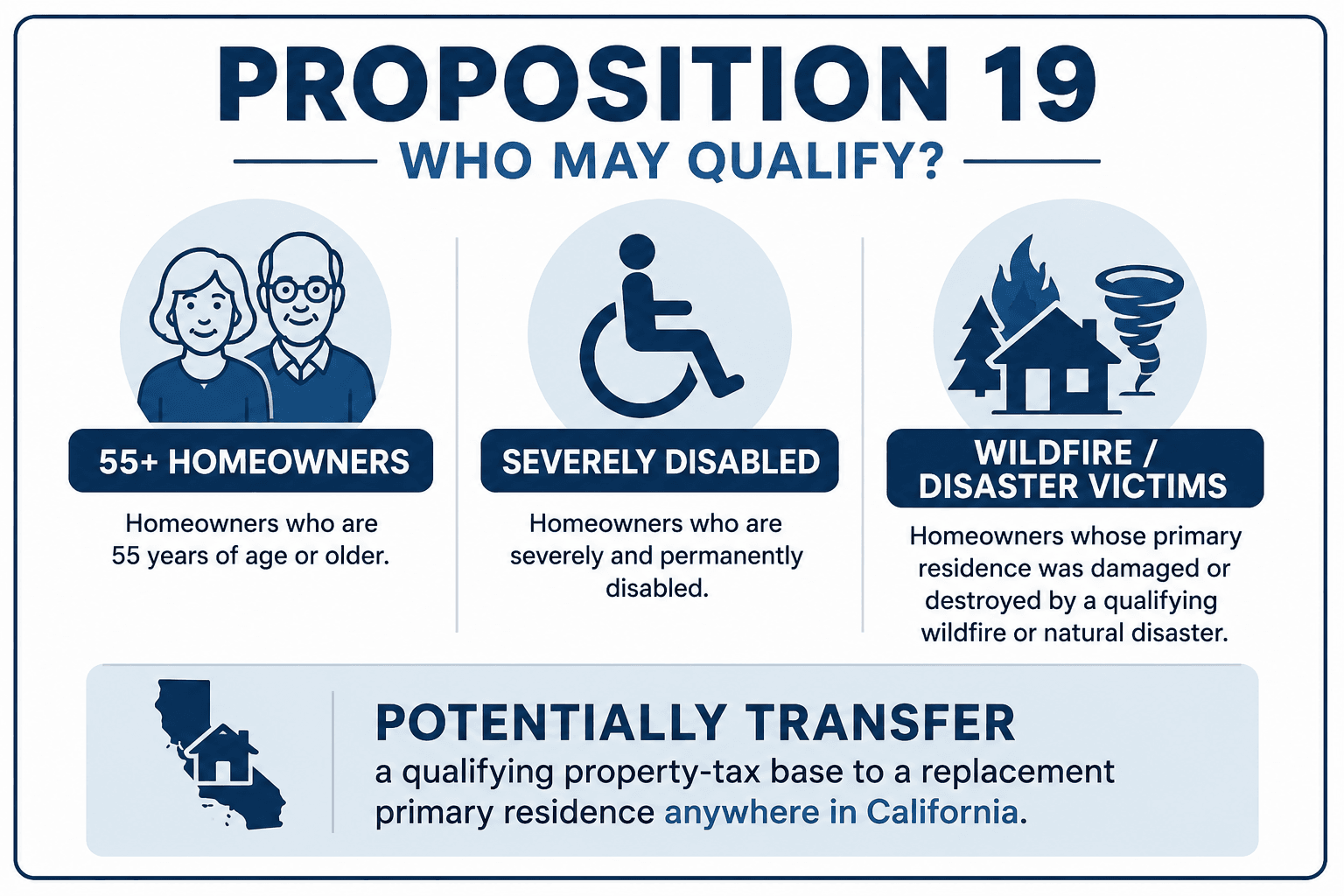
For the replacement-home provisions we're discussing, a homeowner may qualify if they are:
55 or older.
The homeowner must generally be at least 55 years old when the original primary residence is sold.
Severely and permanently disabled.
Different documentation and requirements apply to claims based on disability.
A qualifying victim of a wildfire or natural disaster.
Separate rules apply to these transfers.
For homeowners qualifying based on age or disability, Proposition 19 generally allows the base-year value to be transferred up to three times.
Can I Transfer My Property-Tax Base Anywhere in California?
Yes.
One of Proposition 19's major changes was allowing qualifying homeowners to transfer their base-year value to a replacement primary residence anywhere in California.
So someone could potentially sell a longtime home in Orange County and purchase a qualifying replacement residence in Riverside County, San Diego County, Northern California or elsewhere in the state.
The replacement property does not have to be in the same county.
For Orange County homeowners, the Orange County Assessor provides additional information about Proposition 19 replacement-home transfers, including eligibility, timing and claim information.
Does the New Home Have to Cost Less?
No.
This is another important feature of Proposition 19.
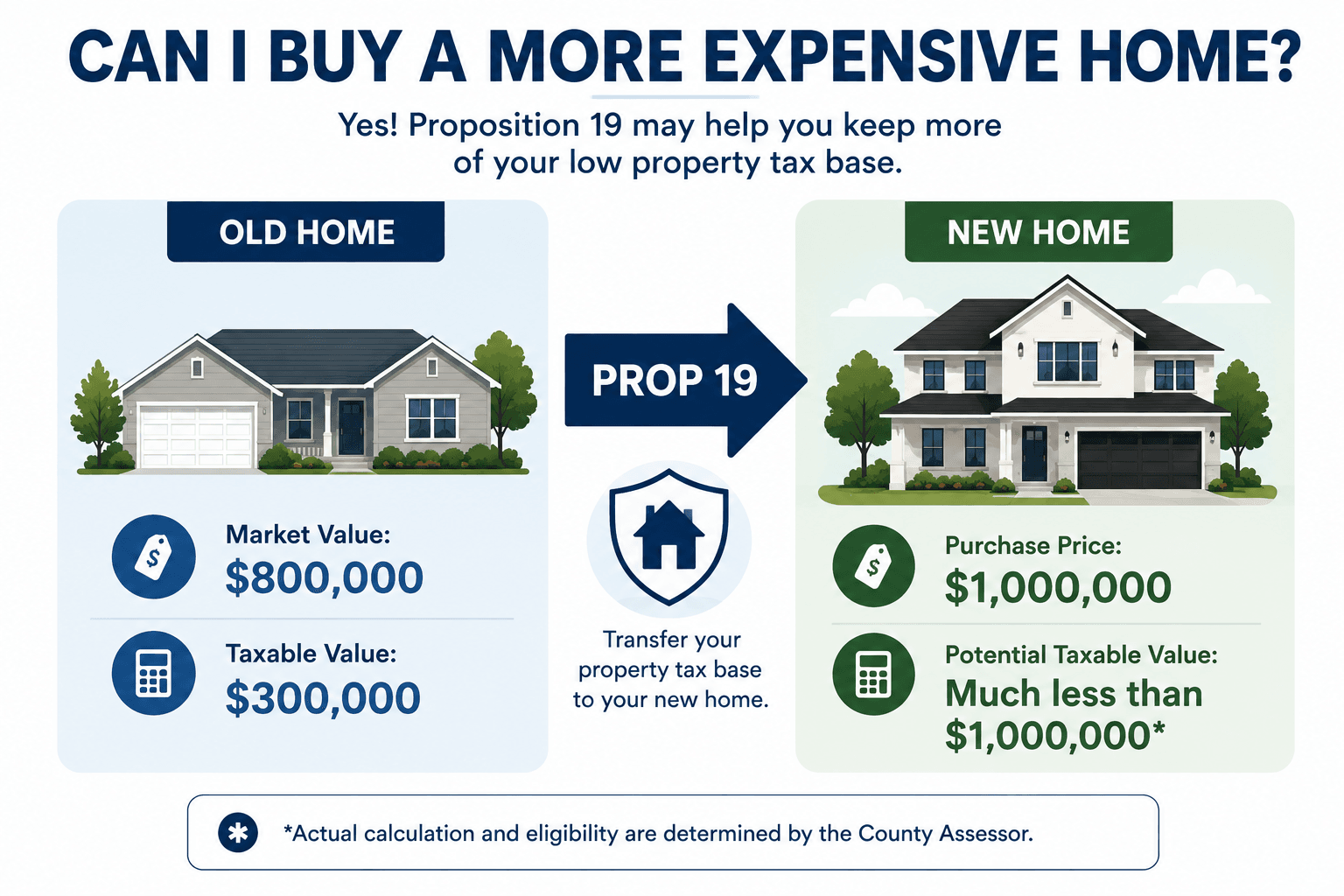
A qualifying homeowner can purchase a more expensive replacement property and still potentially receive a property-tax benefit.
However, purchasing a more expensive home does not necessarily mean the entire new property receives the old taxable value.
The calculation depends partly upon the value of the original property, the replacement property's value and when the replacement property is acquired.
Generally, the "equal or lesser value" thresholds are:
When the replacement property's value exceeds the applicable threshold, the excess is generally added to the transferred base-year value.
A Simple Proposition 19 Example
Imagine a qualifying homeowner has:
Existing taxable value: $300,000
Original home's market value at sale: $800,000
The homeowner then purchases a replacement home within the first year after the sale.
Because the applicable threshold may be 105%, the comparison value could be:
$800,000 × 105% = $840,000
If the replacement home is worth $1,000,000, the amount exceeding that threshold would be:
$1,000,000 − $840,000 = $160,000
A simplified calculation of the replacement home's new taxable value could therefore be:
$300,000 transferred base-year value + $160,000 excess = $460,000 taxable value
That's dramatically different from simply assuming the new $1 million purchase will be taxed based on a $1 million assessed value.
Actual assessments are determined by the County Assessor, so this example is intentionally simplified.
But it demonstrates why Proposition 19 can be so powerful.
How Long Do You Have to Buy the Replacement Home?
Generally, the replacement primary residence must be purchased or newly constructed within two years of the sale of the original primary residence.
Interestingly, the replacement home can be purchased before or after the original residence is sold, provided the requirements are satisfied.
Timing matters because it can affect both eligibility and the value calculation.
That's another reason I recommend discussing Proposition 19 early in the process rather than waiting until after closing.
Does the Homeowner Have to Live in the New Property?
Yes.
For the base-year transfer discussed here, this isn't simply a strategy for buying another investment property.
The original residence must meet the applicable principal-residence requirements, and the qualifying homeowner must own and occupy the replacement residence as their principal residence when the claim is filed.
This was the key issue in the family's situation I described earlier.
Mom wasn't simply giving money toward her daughter's home and moving into a spare bedroom.
The new property was going to become Mom's home too.
Once we recognized that, it made sense to ask whether the ownership structure should reflect that and whether Proposition 19 could benefit the family.
Don't Add Someone to Title Just for Proposition 19 Without Getting Advice
There's an important caution here.
Don't read this story and automatically decide to put Mom, Dad or anyone else on title simply to obtain a property-tax benefit.
How title is held can affect estate planning, inheritance, financing, liability, capital gains and other legal and tax issues.
This can become especially important when a property is owned in a trust or involved in a probate or inherited-property transaction.
Every family's circumstances are different.
The lesson isn't:
"Put Mom on title.
"It's:
"Ask the question before you close."
Your Realtor, title professional, lender, County Assessor, CPA and estate-planning attorney may each see the transaction from a different perspective.
That collective knowledge can be extremely valuable.
I've also created a collection of California title and real estate resources to help homeowners and real estate professionals identify questions worth asking before a transaction gets too far along.
Do I Have to Apply for Proposition 19?
Yes.
Proposition 19's property-tax benefit isn't something homeowners should assume will automatically be applied to their replacement property.
A claim is filed with the Assessor in the county where the replacement property is located.
For an age-55 transfer, that is generally the BOE-19-B, Claim for Transfer of Base Year Value to Replacement Primary Residence for Persons at Least Age 55 Years.
Claims based on disability or disaster circumstances use different forms.
Homeowners can find the applicable Proposition 19 claim forms and filing information through the California State Board of Equalization.
For full relief, homeowners generally should file within three years of purchasing or completing construction of the replacement residence. Claims filed later may still receive prospective relief.
Because the County Assessor ultimately determines eligibility and the assessed value, homeowners should confirm the filing requirements directly with the Assessor where the replacement property is located.
Want a Proposition 19 Reference You Can Keep?
Proposition 19 has several moving parts, and this article intentionally focuses primarily on the replacement-home provisions.
I've also made available a Corinthian Title Company Proposition 19 Guide that includes comparison charts covering:
Keep in mind that the guide and this article are educational resources. Proposition 19 can involve legal, tax and estate-planning considerations, so specific situations should be reviewed with the appropriate professionals.
Why Proposition 19 Matters for California Homeowners
California homeowners who have owned their properties for many years can sometimes feel trapped.
Their house may have appreciated dramatically, while Proposition 13 has helped keep their taxable value relatively low.
Buying another property could otherwise mean establishing a much higher taxable value.
Proposition 19 was designed, in part, to give qualifying homeowners greater flexibility to move without necessarily giving up all of the benefit associated with their existing property-tax base.
For some homeowners, that could change the economics of:
That's why Proposition 19 is worth understanding before you sell, not afterward.

The Most Important Lesson From This Family's Story
I'm glad we caught the Proposition 19 opportunity for this family.
But there's another part of this story that I'm especially proud of.
I wasn't even the title provider on their purchase.
I was handling Mom's sale.
I happened to understand what the family was trying to accomplish, recognized a potential issue and brought it to their Realtor's attention.
That's what I believe good service should look like.
Real estate transactions aren't simply files that need to get from opening to closing.
There are real people on the other side making some of the largest financial decisions of their lives.
Sometimes the most valuable thing I can do isn't solve a title problem. That's why I appreciate being involved early.
Sometimes it's simply recognize something that deserves another look.
In this case, an extra set of experienced eyes may have saved a family thousands of dollars in future property taxes.
That's a pretty good reminder that who you have on your real estate team matters.
Frequently Asked Questions About California Proposition 19
Before You Sell, Ask the Question
If you—or one of your clients—has owned a California home for many years and is considering a move, don't wait until after the transaction closes to start asking about Proposition 19.
Ask before the property is sold. Ask before deciding how the replacement home will be owned.
The answer may not change anything.
But sometimes it can make a very big difference.
And if you're a Realtor working with a homeowner who may qualify, bring your title professional into the conversation early.
You never know what that second or third set of experienced eyes might catch.
Have a transaction where something doesn't quite fit the normal mold?
If you're a Realtor, homeowner or real estate professional and there's a title question worth looking at before you close, reach out and let's take a look at it together.

ABOUT THE AUTHOR
About Adrian Crandall
Senior Sales Executive | Corinthian Title Company
Real estate is full of moving parts—and the best decisions happen when someone helps connect the dots.
For more than 25 years, I’ve helped Southern California Realtors, lenders, escrow professionals, attorneys, investors and homeowners navigate title issues, housing policy, market trends and the hidden details that can delay a closing.
Through The AC Current and my Connecting the Dots series, my goal is to help real estate professionals stay informed, protect their clients and remain one step ahead.
Questions about title, vesting, probate, fraud prevention or a transaction? I’m always happy to be a resource.

Continue Connecting the Dots
More practical insight on title, housing policy, fraud prevention and Southern California real estate.



Stay Ahead of Southern California Real Estate
Each month, The AC Current delivers practical insight on market conditions, title issues, housing policy, fraud prevention, property taxes, probate and trust transactions.
Get The AC CurrentHelping Southern California real estate professionals connect the dots before they become closing-day surprises.
Keeping Title Cool with AC
This article is for general educational purposes only and is not intended as legal, tax or financial advice. Proposition 19 eligibility, base-year-value transfers and property assessments are determined by the appropriate County Assessor. Consult the County Assessor and qualified legal, tax and estate-planning professionals regarding your specific circumstances.