
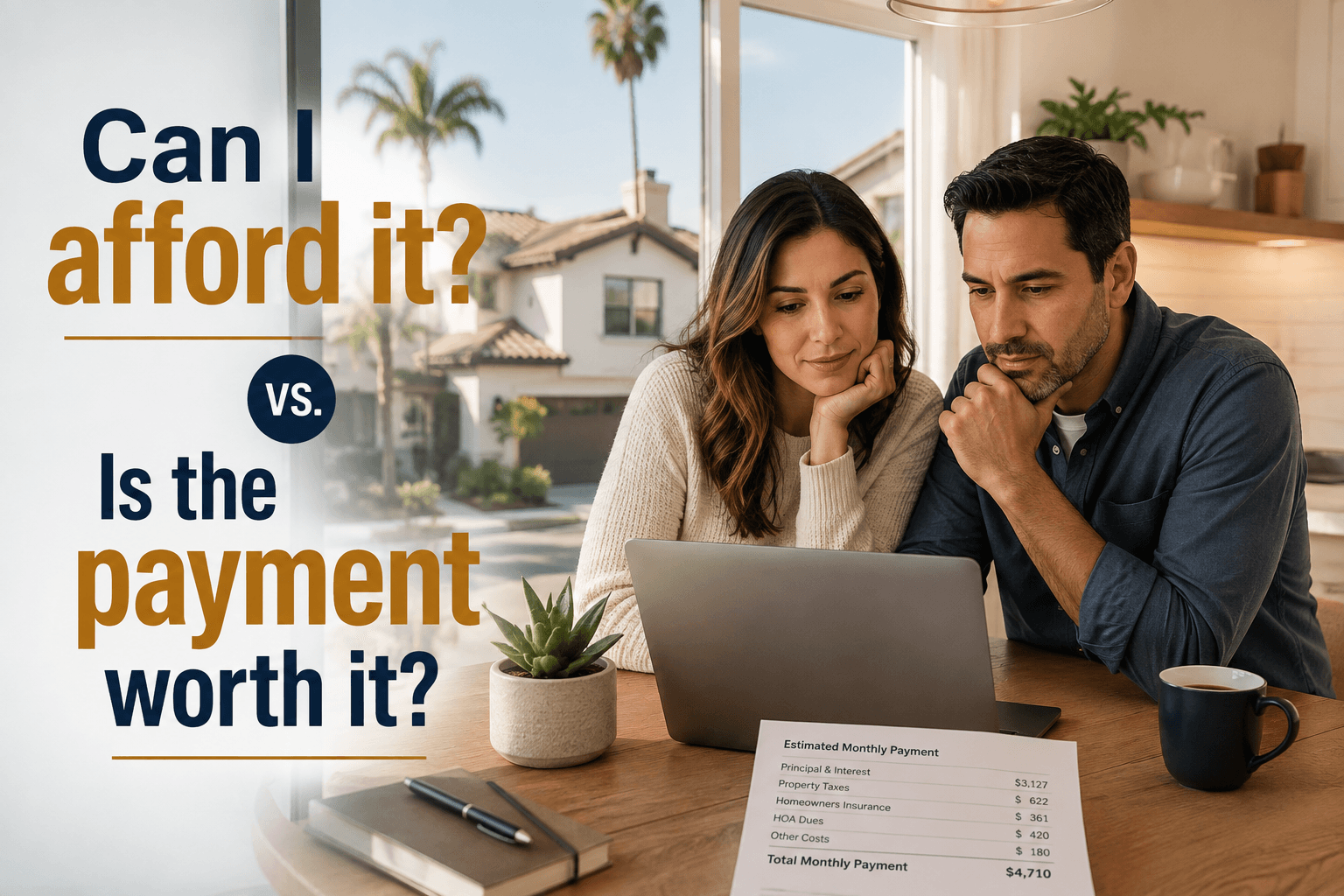
If you ask me what the biggest challenge is in today's Southern California real estate market, I don't think it's inventory.
I don't think it's even mortgage rates.
I think it's payment psychology.
Buyers aren't simply asking, "Can I qualify for this house?"
They're asking a much more personal question:
"Do I really want to make that payment every month?"
That's an important distinction.
A buyer may qualify on paper.
They may have the income, credit and down payment necessary to purchase the home.
But when they see the actual monthly payment—with the mortgage, property taxes, homeowners insurance, HOA dues and everything else that comes with owning the property—the conversation changes.
The question is no longer whether they can buy.
It's whether buying feels worth it.
And I think understanding that difference is becoming increasingly important for buyers, sellers and the real estate professionals advising them.
Southern California Housing Affordability Is Still Historically Tight
The latest numbers help put this into perspective.
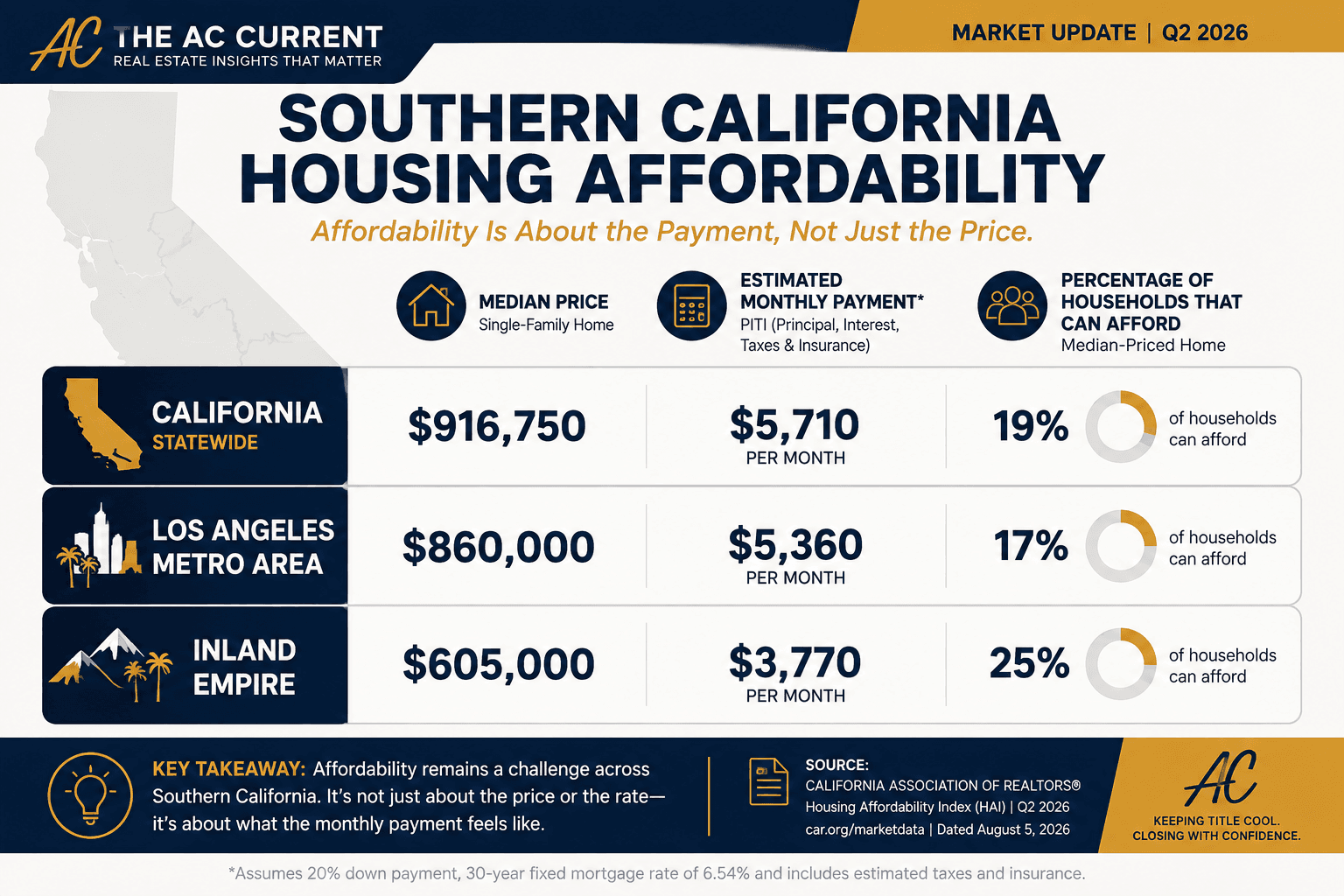
According to the California Association of REALTORS®, only 19% of California households could afford the state's median-priced single-family home during the second quarter of 2026.
That median-priced home was $916,750.With a 20% down payment and an effective mortgage rate of 6.54%, C.A.R. estimated the monthly principal, interest, taxes and insurance at approximately $5,710 per month.
The estimated income needed to qualify?
$228,400 per year.
Southern California tells a similar story.In the Los Angeles Metro area, the median-priced home was approximately $860,000, with an estimated monthly payment of $5,360. Only about 17% of households could afford the median-priced home.
In the Inland Empire, the median was considerably lower at approximately $605,000, with an estimated payment of $3,770—but even there, only about 25% of households met C.A.R.'s affordability standard.
Those numbers tell me something important.
Affordability isn't just an interest-rate problem.
It's a total-payment problem.
Buyers Don't Live in an Interest Rate. They Live in a Monthly Budget.
Mortgage rates get most of the headlines.
I understand why.
Moving from a 7% mortgage to 6% can make a meaningful difference in someone's payment.
But nobody writes a check every month for their "interest rate."
They write checks for housing.
The real cost of owning a home can include:
That's why two homes with the same purchase price can feel very different financially.
One may have an HOA.
One may have higher insurance costs.
One may need a roof, HVAC system or other major improvement shortly after closing.
One buyer may be putting 20% down while another is using FHA financing or a lower-down-payment conventional loan.
Purchase price is only one piece of the affordability puzzle.
The better question is:
What does this particular house look like inside your monthly budget?
That's a conversation worth having before falling in love with a property.
The "Cost of Waiting" Isn't As Simple As It Sounds
This is where I think buyers deserve a more balanced conversation.
You've probably heard some version of:"
Don't wait to buy. The cost of waiting will only make the house more expensive."
Sometimes that's true.
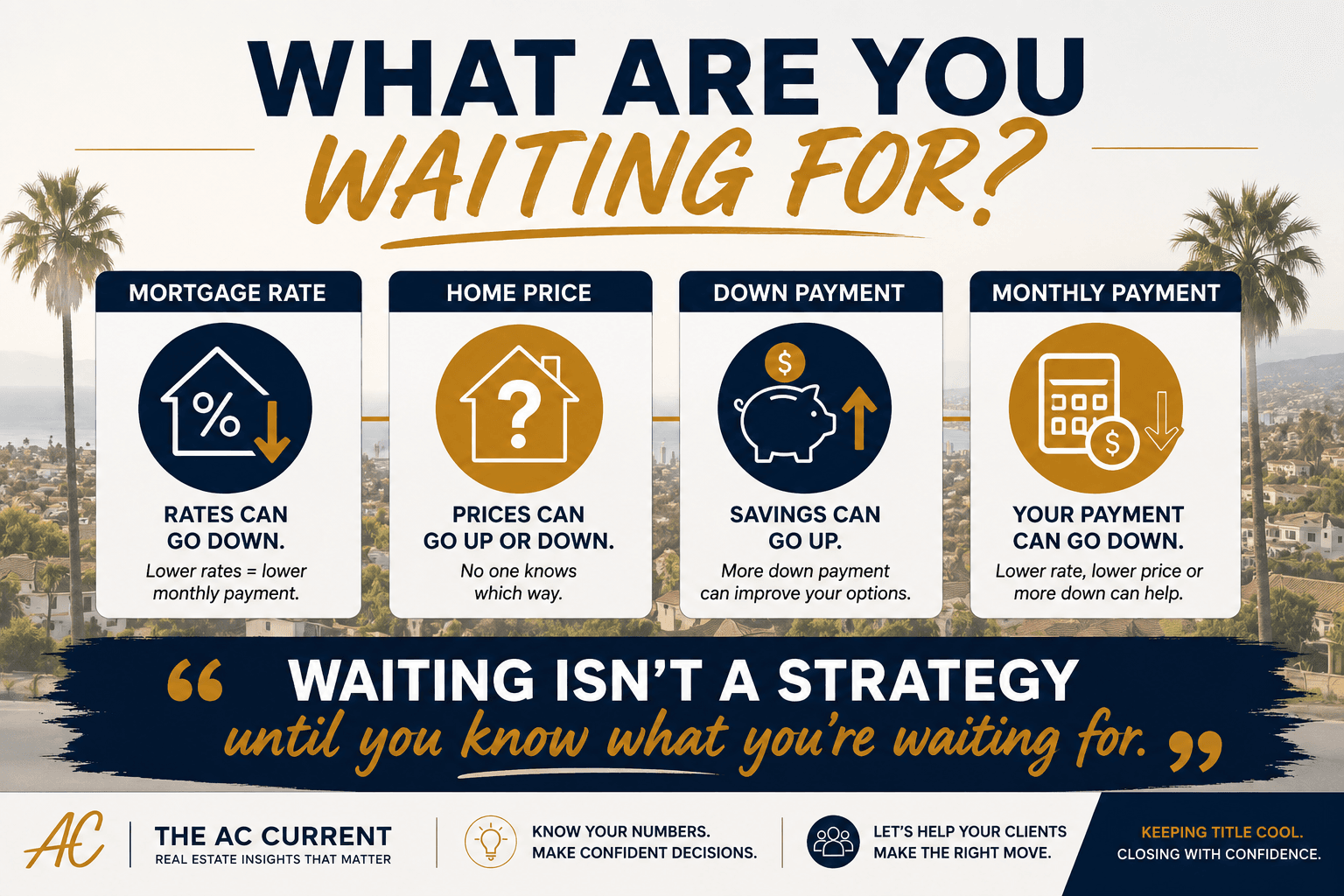
But nobody knows with certainty what home prices or mortgage rates will do next.
Rates could fall.
Prices could rise.
Prices could soften.
Inventory could improve.
A buyer's income could increase.
Their financial situation could change.
So instead of telling someone that waiting is automatically a mistake, I think we should help them understand what they're actually waiting for.
Suppose a buyer is looking at an $800,000 home.
They decide not to buy because they're hoping mortgage rates will fall.
That's reasonable.
But now imagine rates eventually fall about half a percentage point while the price of the home they want increases 5%.
The lower interest rate helps.
But they're now financing a more expensive property, bringing more money to the down payment and potentially paying higher property taxes because of the higher purchase price.
A lower rate doesn't necessarily mean dramatically better affordability.
On the other hand, if rates fall and home prices stay flat—or the buyer saves a substantially larger down payment—waiting could absolutely improve the numbers.
That's why "wait for rates to come down" isn't really a strategy until you do the math.
Before You Wait, Answer These Five Questions
If you're thinking about buying but considering sitting on the sidelines, I'd start here:
1. What payment would actually feel comfortable?
Not the maximum payment a lender says you can qualify for.
Your comfortable payment.
There can be a big difference.
2. What would need to change for you to buy?
Would you buy if rates dropped 0.5%?
What about 1%?
Do you need another $25,000 saved?
Would a lower-priced property make more sense?
Defining the target makes waiting intentional instead of indefinite.
3. What happens if prices change while you're waiting?
Run more than one scenario.
What happens if rates decline but prices rise?
What happens if rates stay relatively flat?
What happens if prices soften?
Nobody knows which scenario will happen, but seeing the numbers can help you make a better decision.
4. How much are you spending on housing while you wait?
Rent isn't automatically "throwing money away."
It provides housing and flexibility.
But it is still part of the calculation.
If waiting another year means spending $36,000 in rent, that's worth considering alongside the potential savings you're hoping to achieve by waiting.
5. How long do you expect to own the home?
This may be the most overlooked question.
Buying a home generally makes more sense when you're looking beyond the next year or two.
If you're planning to stay for a longer period, today's exact interest rate may matter less than finding the right property at a payment you can comfortably manage.
And if rates eventually fall enough to make refinancing worthwhile, refinancing may become an option.
Run the Numbers Before You Decide
One of the best things you can do before deciding whether to buy, wait or adjust your price range is to get a clearer picture of the actual numbers.
And you don't necessarily need to wait until you're in escrow to start doing that.
I provide Realtors with access to the Corinthian Gold Closing Cost Calculator, a tool designed to quickly estimate closing costs and run different purchase scenarios for their clients.
For Realtors, this can be especially useful when you're sitting with a buyer and asking:
“What would have to change for this payment to make sense?”
Instead of guessing, you can start running scenarios.
What happens if we change the purchase price?
What if the down payment changes?
What do the estimated closing costs look like?
How much cash might the buyer need to close?
The goal isn't to predict the market.
It's to help buyers better understand their options.
Closing-cost estimates • Purchase scenarios • Realtor-friendly
Calculations are estimates for informational purposes and should be confirmed with the appropriate real estate, lending, escrow and title professionals.
Sellers Need to Understand Payment Psychology Too
This isn't only a buyer issue.
Sellers need to understand what's happening on the other side of the transaction.
A $10,000 or $20,000 difference in price may not sound significant when discussing an $800,000 or $1 million property.
But buyers aren't necessarily thinking about that difference as a percentage of the purchase price.
They're thinking:
"What does that do to my payment?"
That means pricing correctly from the beginning matters.
So does understanding buyer incentives.
Depending on the transaction, a credit toward closing costs or an interest-rate buydown may sometimes be more meaningful to a buyer than simply reducing the purchase price by the same dollar amount.
That's a conversation sellers should have with their Realtor and the buyer's financing team rather than assuming price is the only lever available.
Realtors Have an Opportunity to Change the Conversation
This is where I think good real estate professionals can really separate themselves.
Today's buyer doesn't necessarily need someone to convince them that homeownership is a good idea.
They need someone who can help them understand their options.
Instead of asking:"
Are you ready to buy?"
Try asking:
"What would have to be true for buying to make sense for you?"
That's a different conversation.
Maybe it's a certain payment.
Maybe it's a particular neighborhood.
Maybe it's enough space for a growing family.
Maybe it's getting out of an apartment.
Maybe it's finding a property with an ADU that can help offset the payment.
Maybe they're willing to buy now if the seller helps with closing costs.
Once you understand the real concern, you can assemble the right professionals and start solving the actual problem.
That's much more valuable than simply sending another list of homes.
My Perspective: Don't Predict. Prepare.
I've spent more than 25 years working around Southern California real estate transactions, and I've watched markets change many times.
Rates change.
Inventory changes.
Prices change.
Buyer confidence changes.
What I've learned is that trying to perfectly time the market is incredibly difficult.
I would rather see someone understand the numbers and make a decision that works for their family.
For some people, that means buying today.
For others, waiting is absolutely the right decision.
But if you're going to wait, know what you're waiting for.
Set the payment.
Set the savings goal.
Run the scenarios.
Understand the tradeoffs.
Then, when the right opportunity appears, you're making a decision based on preparation rather than headlines.
Because in this market, the question isn't simply:
"Can I afford to buy a home?"
The better question may be:
"At what price, payment and circumstances does buying a home make sense for me?"
That's a question worth answering.
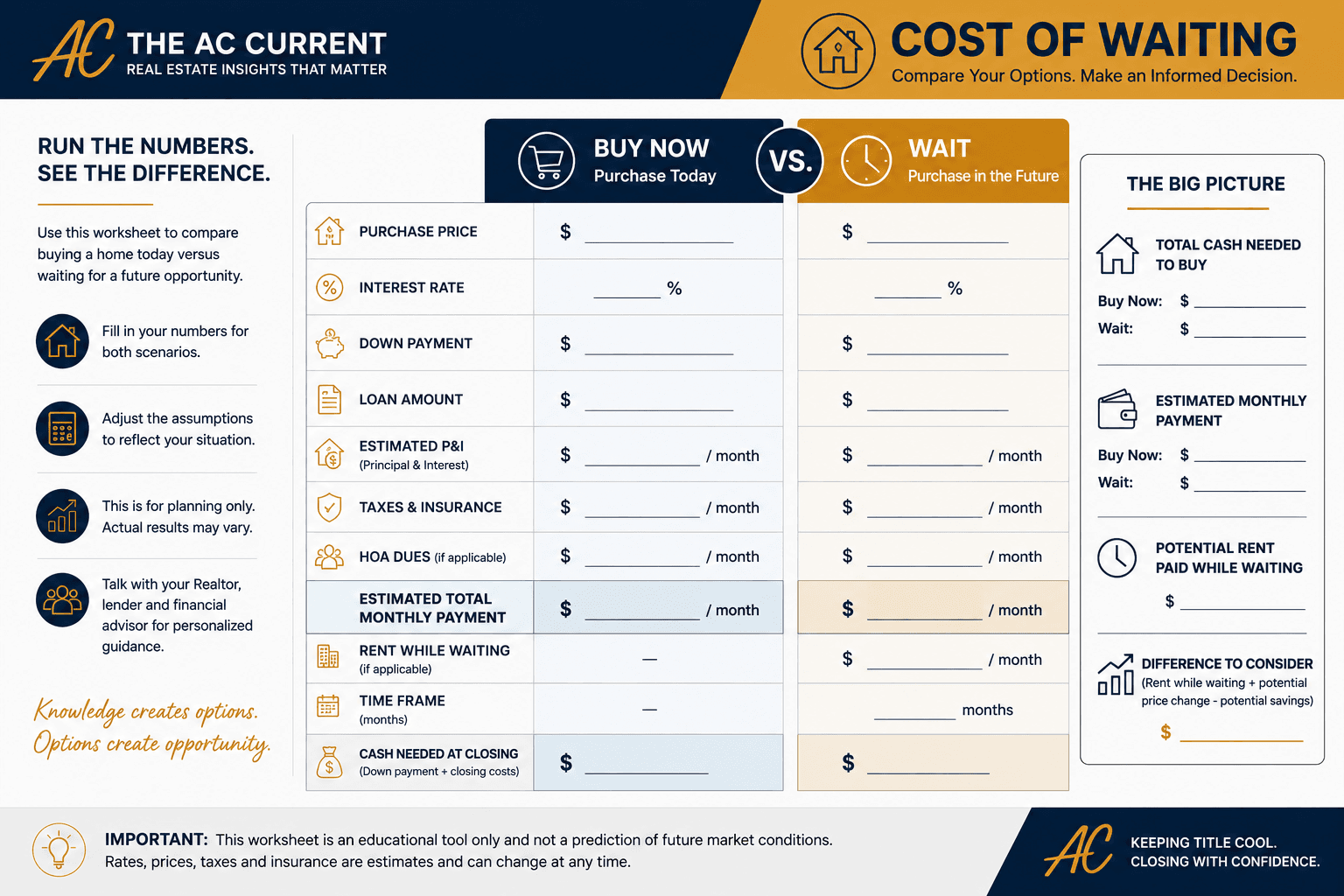
Want to take this a step further? Use the worksheet above to compare your assumptions, then use the Corinthian Gold Closing Cost Calculator to estimate the closing costs associated with an actual purchase scenario.
Closing-cost estimates • Purchase scenarios • Realtor-friendly
Frequently Asked Questions

ABOUT THE AUTHOR
About Adrian Crandall
Senior Sales Executive | Corinthian Title Company
Real estate is full of moving parts—and the best decisions happen when someone helps connect the dots.
For more than 25 years, I’ve helped Southern California Realtors, lenders, escrow professionals, attorneys, investors and homeowners navigate title issues, housing policy, market trends and the hidden details that can delay a closing.
Through The AC Current and my Connecting the Dots series, my goal is to help real estate professionals stay informed, protect their clients and remain one step ahead.
Questions about title, vesting, probate, fraud prevention or a transaction? I’m always happy to be a resource.

Continue Connecting the Dots
More practical insight on title, housing policy, fraud prevention and Southern California real estate.



Stay Ahead of Southern California Real Estate
Each month, The AC Current delivers practical insight on market conditions, title issues, housing policy, fraud prevention, property taxes, probate and trust transactions.
Get The AC CurrentHelping Southern California real estate professionals connect the dots before they become closing-day surprises.
Keeping Title Cool with AC
Information provided is for educational purposes only and is not financial, tax, legal or lending advice. Buyers should consult the appropriate licensed professionals regarding their individual circumstances.