
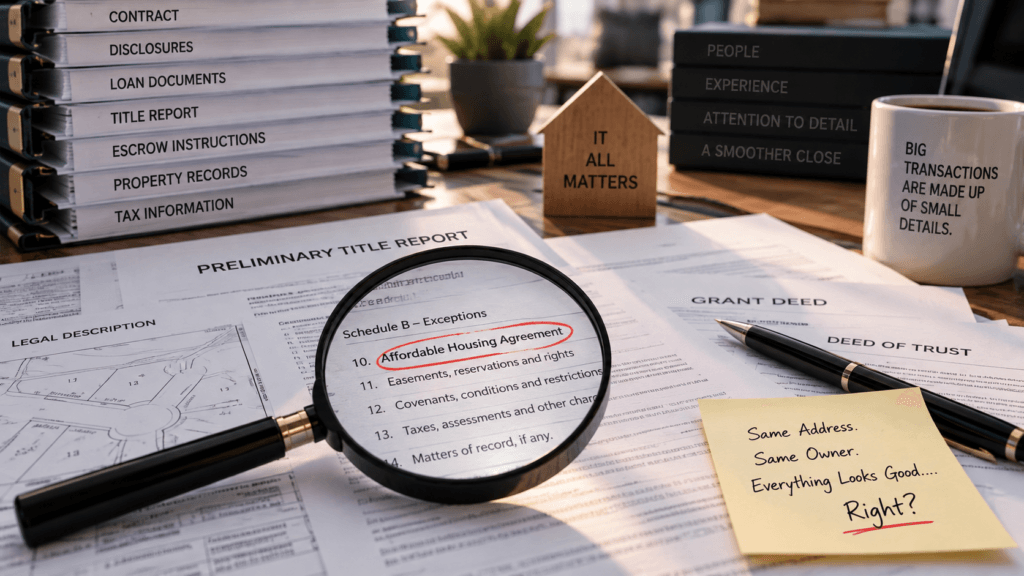
A real estate transaction might involve $800,000, $1 million or several million dollars.
There are Realtors, lenders, escrow officers, title professionals, transaction coordinators, inspectors, appraisers, insurance agents and countless others involved.
There are contracts, disclosures, deeds, loan documents, tax records, recorded documents and signatures everywhere.
And sometimes the thing that causes the biggest problem is ridiculously small.
One number.
One name.
One document.
One box that wasn't checked.
Think about something as basic as the property address.
How many times is that address typed, copied, transferred or verified by different people throughout a transaction?
I'd guess dozens.
And that's just one piece of information.
Now multiply that by the thousands of details that have to be right for ownership of a property—and potentially hundreds of thousands of dollars—to safely change hands.
That's why something I've learned after nearly 30 years in real estate is incredibly simple:
Never assume something is correct just because someone else already looked at it.
I'll give you an example from the part of the transaction I know best.
Your preliminary title report.
What Actually Goes Into a Preliminary Title Report?
For most Realtors, ordering title is pretty simple.
You send over an address, open the order and eventually a preliminary title report shows up in your inbox.
But there's quite a bit happening behind the scenes between those two points.
At Corinthian Title, one of the first stops is our Customer Service department.
They identify the property and pull the legal description and current vesting information.
That information is sent to escrow early in the process so we can start by confirming two very basic—but very important—things:
Do we have the right property?
And do we have the right owners?
From there, the order moves into searching.
Our searching department researches the public record to identify documents that have been recorded against the property and other matters that may affect title.
Deeds. Deeds of trust. Liens. Easements. Judgments. Releases. Reconveyances.
Potentially decades of recorded history.
But finding those documents is only part of the job.
Someone still has to determine what they mean today.
Putting the Puzzle Together
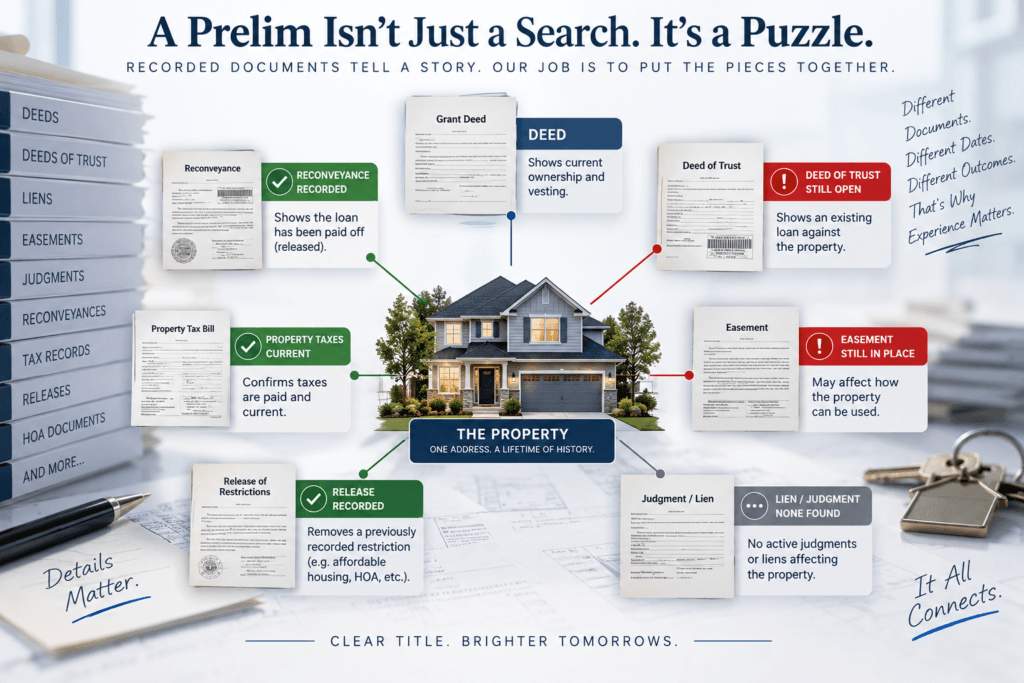
That's where examining comes in.
The examiner reviews the information uncovered during the search and begins reconstructing the history of the property.
Who owned it?
How did they acquire it?
How was ownership transferred?
What loans were recorded?
Which have since been paid and reconveyed?
Are there liens that still affect the property?
What easements and other exceptions need to appear?
Are the property taxes current?
Does the legal description match the property we're supposed to be insuring?
A loan recorded 20 years ago may have been paid off 18 years ago.
A judgment appearing under someone's name may belong to an entirely different person.
An easement recorded decades ago may still affect the property today.
A deed somewhere in the chain may have created an issue that needs to be resolved before the new owner can receive clear title.
The examiner isn't simply finding documents.
They're determining which pieces of that property's history still matter today.
Once that work is complete, we're still not finished.
The report goes through production, where it's typed, reviewed and revised. Pertinent recorded documents are linked to the appropriate exceptions so the people involved in the transaction can actually review the underlying documents.
Finally, the preliminary title report is delivered.
That's a lot of hands and a lot of details involved in producing one report.
And that's just one part of the real estate transaction.

Here's a Real Example
I recently had one of my longtime clients reach out to me about a townhome he was purchasing for his daughter to live in while she attends college.
There was just one difference from most of the transactions we work on together:
We weren't the title company insuring this one.
He had received a preliminary title report showing an affordable housing restriction affecting the property.
Understandably, that caught his attention.
Depending on their terms, affordable housing restrictions can affect how a property can be sold or occupied, so this wasn't something he wanted to simply ignore.
Then the title company issued a supplemental report removing the restriction.
So everything was fine.
But my client did something I wish more people would do.
He asked why.
He sent me the prelim, the affordable housing agreement and the supplemental report and essentially asked:“It looks like we're good, but is there anything else I should be looking at?”
So I started digging.
And I found another recorded document:
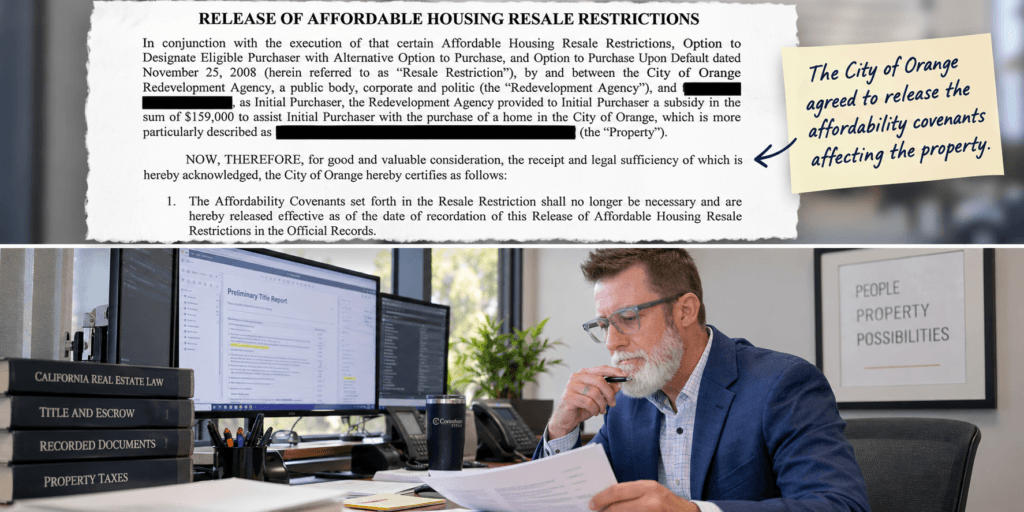
A Release of Affordable Housing Resale Restrictions.
The original resale restriction had been recorded in 2008. The later release states that the purchaser's monetary obligations under the restriction had been satisfied and that the City of Orange agreed to release the affordability covenants affecting the property. The release was executed in 2021 and subsequently recorded.
Suddenly, the title company's supplemental report made a lot more sense.
It appeared the older affordable housing restriction had initially been carried onto the preliminary report even though a subsequent document had released the affordability covenants.
Was the release overlooked initially?
Was something difficult to locate in the public record?
Was there another reason it appeared on the first report?
I wasn't the title company handling the transaction, so I can't tell you exactly what happened.
And that's really not the important part of the story.
What mattered was that my client saw something he didn't understand and asked a question.
The title company removed the restriction, and I was able to find the recorded document that helped him understand why.
He didn't have to simply accept:"Title says we're good."
He could see the reasoning behind it.
And when you're buying a home for your daughter, I think that's a much better answer.
Mistakes Happen
I've worked at large title companies and small title companies throughout my career.
And one thing I've learned is that every title company makes mistakes.
Mine included.
Sometimes a document gets overlooked.
Sometimes something was recorded incorrectly years ago, making it difficult to find.
Sometimes information gets entered incorrectly.
And sometimes it's simply human error.
That's not an indictment of the people doing the work.
It's reality when you're dealing with decades of property history and thousands of individual details.
The more important question is:
How many opportunities do we have to catch something before it becomes a problem?
That's Why I Review Every Prelim
When my company produces a preliminary title report for one of my clients, I personally review it.
I'm looking at the owners.
I'm looking at the loans.
I'm looking at liens and judgments.
I'm looking at taxes and exceptions.
But more than anything, I'm looking for something that doesn't seem to fit the story of the property or the transaction.
Sometimes that means asking our title department a question.
Sometimes it means pulling the underlying recorded document.
Sometimes it means asking the Realtor or escrow officer for more information.
And sometimes it turns out to be nothing.
That's okay.
I'd rather ask an unnecessary question three weeks before closing than discover a necessary question three hours before closing.
That's also why I'm such a believer in reviewing title before a property ever reaches escrow when possible.
And I'm not the only person who should be looking.
You should too.
You don't have to understand everything on a preliminary title report. That's what we're here for.
But you know your transaction.
If the owner's name doesn't look right, ask.
If you see a loan the seller says was paid off years ago, ask.
If there's an easement you don't understand, ask.
If something refers to an agreement you've never heard of, ask.
Some of the best questions I receive from clients begin with:"Adrian, this might be nothing, but..."
Perfect.
Let's find out.
Sometimes the Transaction Matters More Than the Title Order
There's another reason I wanted to share the story about my client's townhome.
My company wasn't insuring the transaction.
There was no title commission in it for me.
My client had a question and trusted me enough to ask for another set of eyes.
And I'm happy to do that.
I'm not reviewing another title company's work hoping to find a mistake. I'm looking because I've spent nearly three decades doing this, and sometimes experience helps you notice something, ask a different question or know where to look next.
Some risks are simply bigger than whether I earn the commission on a particular transaction.
If another set of eyes can give someone peace of mind—or help identify something before it becomes a much bigger problem—I'm happy to take a look.
One More Set of Eyes
There's also something I've come to appreciate after working for different title companies throughout my career.
Where and how the work gets done matters to me.
Different title companies structure their production departments differently.
One thing I'm particularly proud of at Corinthian Title is that our preliminary title reports are produced in-house, right here in Southern California.
The people working on our reports are familiar with California real estate, California documents and the types of title issues we encounter here.
And when I have a question about something on a report, I can communicate with the people doing the work.
I jokingly like to call our prelims:
USA Made.

But even after Customer Service, searching, examining, production and title have had their hands on a file...
I still review it.
Because there's too much at stake to assume everything is right simply because someone else already looked at it.
You Don't Have to Be a Title Expert
Real estate transactions are incredibly detailed.
Most of the time, all those details line up exactly as they're supposed to.
But occasionally one doesn't.
And some of the biggest title problems I've encountered during my career didn't start as big problems.
They started with something small.
A name.
A number.
A document.
A lien.
A signature.
A legal description.
Something that simply didn't look quite right.
That's why there are so many sets of eyes involved in a real estate transaction.
And yours should be one of them.
So the next time a preliminary title report lands in your inbox, don't just file it away because "title looked at it."
Take a look.
Ask questions.
And if something doesn't make sense, speak up.
Not because you should expect something to be wrong.
Because there's too much at stake to simply assume everything is right.
Have a Question About a Preliminary Title Report?
Something doesn't look right? Or maybe you just don't know what you're looking at?
Send it to me.
I've spent nearly 30 years working through title issues, and I'm happy to be a second set of eyes—even if Corinthian Title isn't insuring the transaction.
Sometimes peace of mind starts with simply asking the question.

ABOUT THE AUTHOR
About Adrian Crandall
Senior Sales Executive | Corinthian Title Company
Real estate is full of moving parts—and the best decisions happen when someone helps connect the dots.
For more than 25 years, I’ve helped Southern California Realtors, lenders, escrow professionals, attorneys, investors and homeowners navigate title issues, housing policy, market trends and the hidden details that can delay a closing.
Through The AC Current and my Connecting the Dots series, my goal is to help real estate professionals stay informed, protect their clients and remain one step ahead.
Questions about title, vesting, probate, fraud prevention or a transaction? I’m always happy to be a resource.

Continue Connecting the Dots
More practical insight on title, housing policy, fraud prevention and Southern California real estate.



Stay Ahead of Southern California Real Estate
Each month, The AC Current delivers practical insight on market conditions, title issues, housing policy, fraud prevention, property taxes, probate and trust transactions.
Get The AC Current