
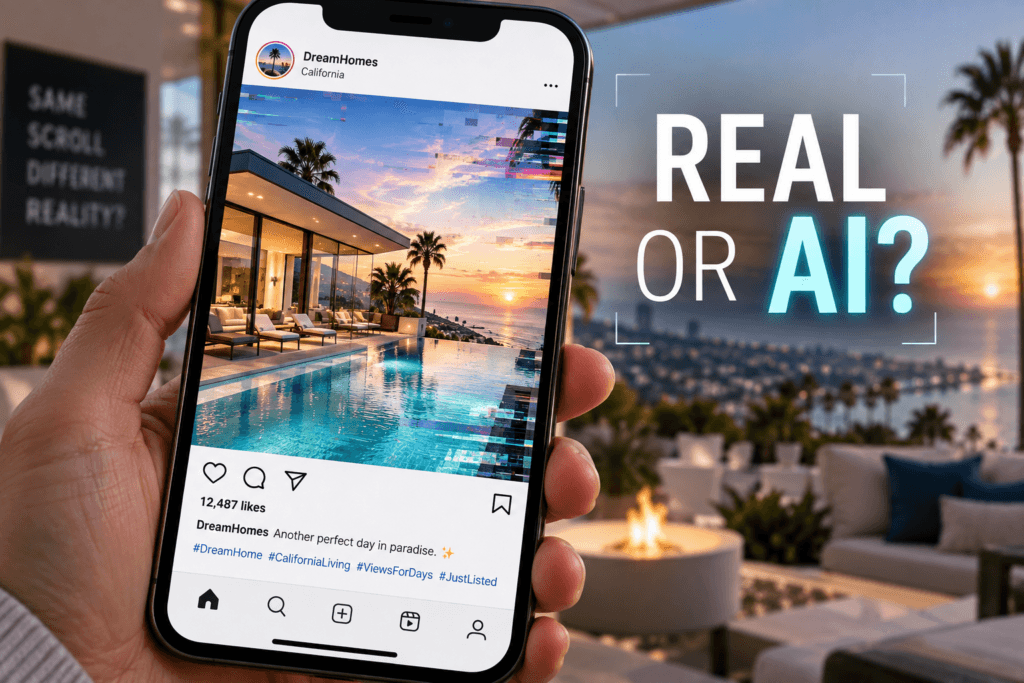
I use AI. I like AI. And lately, I’m starting to get a little tired of AI.
That probably sounds contradictory.
I use artificial intelligence regularly in my business. It helps me research ideas, organize information, brainstorm, improve communication and accomplish things faster than I could have imagined a few years ago.
I think it’s an incredible tool.
But lately, I’ve noticed something happening when I scroll through social media. And it has me thinking differently about AI in real estate, too.
I don't always know what's real anymore.
The perfectly produced video. The celebrity saying something outrageous. The historical figure suddenly giving a motivational speech. The talking animal. The person who looks almost—but not quite—human.
Sometimes I can spot the AI immediately. Other times I watch for 10 or 15 seconds before realizing none of it actually happened.
And increasingly, my reaction isn't amazement.
It's annoyance.
Maybe that's because we're moving beyond the point where AI simply helps us create things. It's beginning to make us question whether the things we're seeing, reading and hearing are real at all.
For those of us in real estate, I think that's worth talking about.
AI in Real Estate Is Part of a Much Bigger Conversation
If you've followed the news lately, you've probably seen some alarming headlines about artificial intelligence.
Some of the very people building the world's most advanced AI systems are publicly debating how quickly this technology should advance and what safeguards should exist. Concerns range from job displacement and cybercrime to autonomous AI systems becoming increasingly difficult for humans to control.
Meanwhile, Americans themselves appear increasingly uneasy about where this is going.
A 2026 Pew Research Center survey found 52% of Americans say they're more concerned than excited about AI, compared with 37% in 2021. Seventy-one percent believe AI will result in fewer jobs in the United States over the next 20 years.
Those are enormous questions.
But I'm a title guy.
I'm probably not going to solve the future of artificial intelligence.
What I can talk about is something much closer to home:
How much AI is too much in real estate?
I don't think the answer is "less AI"
That's where I may differ from some of the conversations we're hearing.
I'm not interested in going backward.
AI can be incredibly valuable to a Realtor.
It can help brainstorm a marketing campaign, analyze information, improve a listing description, organize a database, prepare for a client meeting, develop social media ideas, summarize complicated information or turn an hour-long task into a 10-minute one.
Used correctly, I believe AI can actually make a good real estate professional better.
The problem begins when we stop using AI to support our expertise and start allowing it to substitute for it.
There's a big difference.
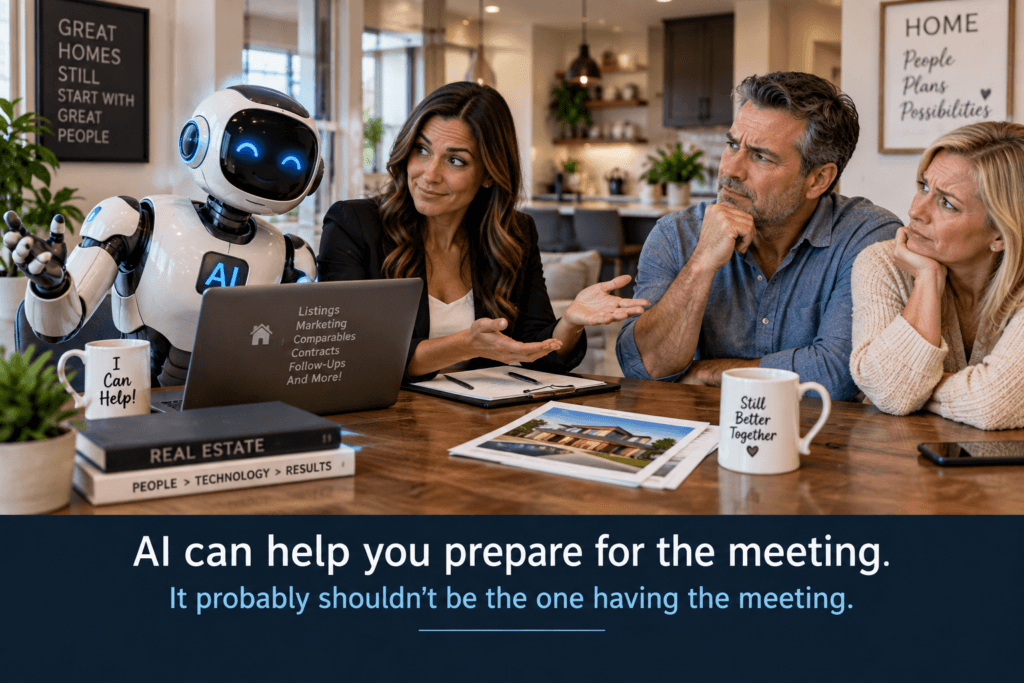
Your client hired you. Not your AI.
Think about how many parts of a Realtor's business could now theoretically be handled by artificial intelligence.
Write the listing description.
Create the social posts.
Write the emails.
Respond to leads.
Create the market update.
Answer property questions.
Analyze documents.
Follow up with past clients.
Generate a video.
Create an avatar that looks like you and potentially even talks like you.
At some point, we have to ask a strange question:
How much of "you" can we automate before your client isn't really working with you anymore?
Real estate has always been a relationship business.
People don't hire a great Realtor because that Realtor can type an email faster than everyone else.
They hire someone because they trust that person's judgment.
They want someone who has been through difficult transactions.
Someone who notices when something doesn't look right.
Someone who knows when to make a phone call instead of sending a text.
Someone who understands the neighborhood.
Someone who can sit across the kitchen table from a nervous seller and explain what happens next.
AI can help prepare you for those moments.
It shouldn't replace them.
Confidence isn't the same thing as accuracy
This is where AI becomes particularly interesting to me as a title professional.
AI is extremely good at sounding confident.
Unfortunately, sounding confident and being correct aren't always the same thing.
An AI system can give you an articulate, detailed, completely reasonable-looking answer that happens to be wrong.
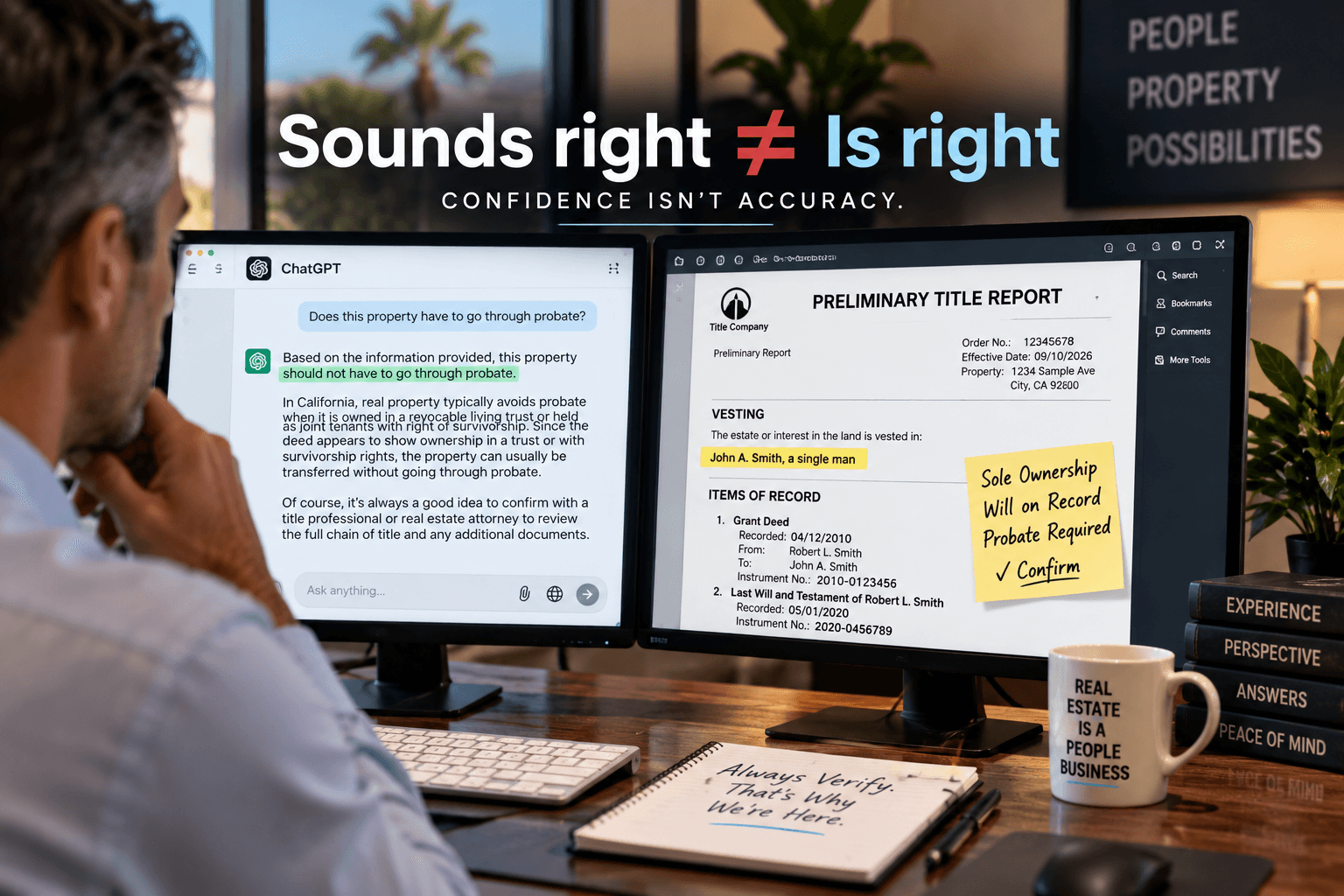
That's not a huge problem when you're asking for ideas for an Instagram caption.
It's a much bigger problem when the question becomes:
"What does this easement mean?"
"Does this lien have to be paid?"
"Can my seller transfer this property out of their trust?"
"What does this exception on the preliminary title report mean?"
"Will this property have to go through probate?"
Those are exactly the kinds of questions where experience, documentation and professional review matter.
AI can be extremely useful in helping someone understand the issue and formulate better questions.
But I would be very careful about allowing it to make the determination.
California's Department of Real Estate has taken a similar position. Its 2026 guidance encourages licensees to think of AI as a support tool rather than an independent decision-maker.
That distinction matters.
Then there's the other side of AI
While legitimate businesses are using AI to become more productive, criminals are discovering the exact same tools.
And they're getting better at it.
Fake sellers.
AI-generated identification.
Voice cloning.
Deepfake videos.
Phishing emails that no longer look like they were written by someone halfway around the world.
Fraudulent wiring instructions that look increasingly legitimate.
The FBI has specifically warned about criminals impersonating owners of vacant land and contacting real estate professionals to sell property they don't own.
This creates an interesting contradiction.
The better technology becomes at imitating humans, the more valuable human verification becomes.
For years, technology has been sold to our industry as a way to remove friction.
Click here.
Automate this.
Don't make the phone call.
Don't talk to someone if you don't have to.
But maybe the next generation of technology changes that equation.
Maybe a five-minute phone call becomes more valuable.
Maybe knowing your client becomes more valuable.
Maybe independently verifying wiring instructions becomes more important.
Maybe relationships with experienced escrow, title, lending and real estate professionals become more important—not less.
That's an angle on AI that I don't hear discussed nearly enough.
AI is also creating a trust problem
This might actually concern me more than whether AI takes someone's job.
Think about what happens when consumers become accustomed to seeing fake content every day.
Fake photographs.
Fake videos.
Fake voices.
Fake testimonials.
Fake people.
Fake news clips.
Eventually, we don't just distrust the fake things.
We start questioning the real things too.
That's a very different problem.
Real estate transactions require an enormous amount of trust.
Buyers and sellers are transferring hundreds of thousands—or millions—of dollars. They're signing legal documents. They're sharing financial information. They're relying on professionals they've sometimes known for only a few weeks.
Trust isn't a nice bonus in our industry.
It's part of the infrastructure.
So while everyone races to figure out how much content AI can create, maybe real estate professionals should be asking another question:
Will this make people trust me more—or less?
That's a filter I think we should start using.
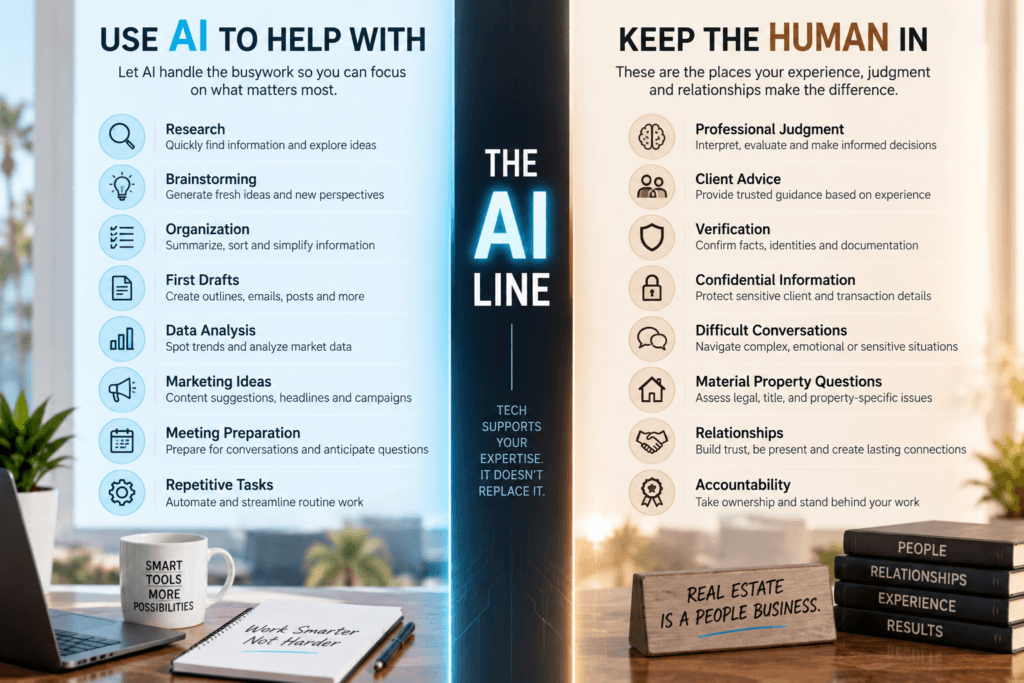
Where I draw the AI line
I don't have a perfect formula.
I'm still figuring this out myself.
But I'm beginning to think about AI in two categories.
I want AI doing more of the things that allow me to spend more time being human.
Research.
Organization.
Brainstorming.
Data analysis.
First drafts.
Preparing for meetings.
Identifying questions I may not have considered.
Handling repetitive tasks.
Those are places where AI can be fantastic.
But I'm much more cautious when technology begins replacing things involving judgment, accountability, authenticity or relationships.
Interpreting a complicated title issue.
Giving professional advice.
Making material representations about a property.
Handling confidential client information.
Verifying someone's identity.
Having a difficult conversation.
Making the phone call.
Building the relationship.
Those are places where I want a human being involved.
Maybe efficiency isn't the ultimate goal
For years, technology has promised to make us more efficient.
And most of the time, that's a good thing.
But I'm starting to wonder if we've made efficiency itself the goal.
It shouldn't be.
If AI saves a Realtor five hours a week and those five hours are spent talking with clients, prospecting, studying their market, visiting properties and strengthening relationships, that's an incredible use of technology.
If AI saves five hours so we can generate 50 more AI posts that nobody really wants to read anyway, I'm not sure we've accomplished much.
Maybe the question isn't:
"How much of my business can AI do?"
Maybe it's:
"What can AI take off my plate so I have more time to do the things that actually matter?"
That's a very different approach.
The irony of all this
I'm writing an article about being cautious with AI.
And yes—I used AI to help me write it.
I don't think that's hypocritical.
I think that's actually the point.
The ideas are mine. The concerns are mine. The experiences are mine. The perspective comes from years of working in title and watching technology continually change our industry.
AI helped me organize those thoughts and communicate them.
That's exactly how I think this technology should work.
AI doesn't need to replace our voice. It can help us use our voice better.
And maybe that's where I land on all of this.
I'm not afraid of AI.
I'm certainly not giving it up.
But I also don't want to reach a point where technology designed to help us communicate actually makes everything feel less authentic.
Especially in real estate.
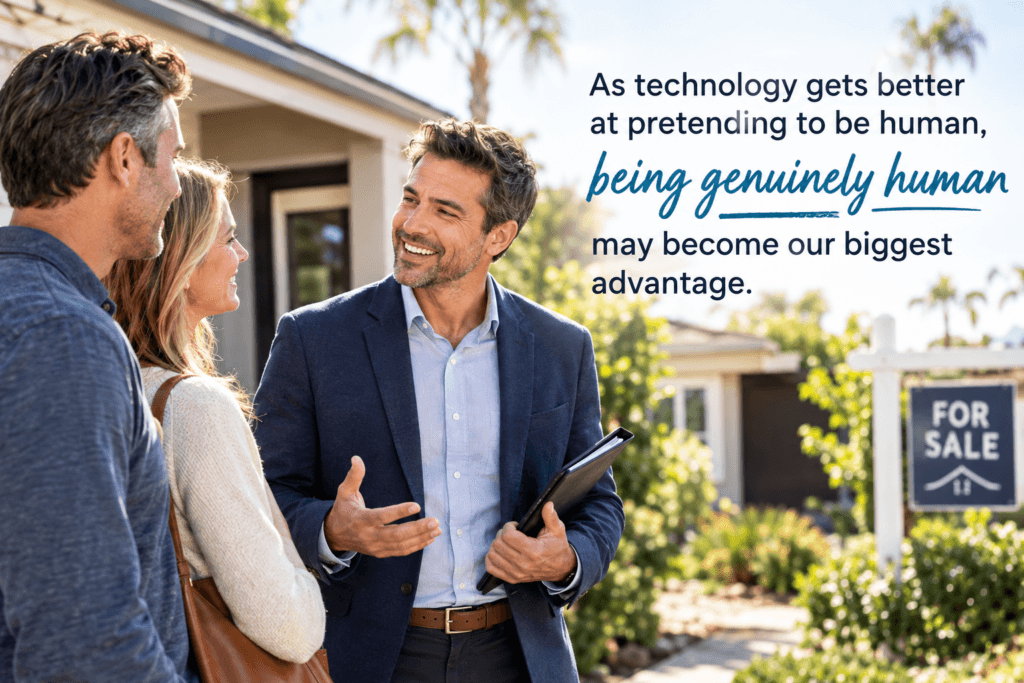
Because as our technology gets better at pretending to be human, I suspect being genuinely human is going to become one of our biggest competitive advantages.
Keeping Title Cool. Closing with Confidence.

ABOUT THE AUTHOR
About Adrian Crandall
Senior Sales Executive | Corinthian Title Company
Real estate is full of moving parts—and the best decisions happen when someone helps connect the dots.
For more than 25 years, I’ve helped Southern California Realtors, lenders, escrow professionals, attorneys, investors and homeowners navigate title issues, housing policy, market trends and the hidden details that can delay a closing.
Through The AC Current and my Connecting the Dots series, my goal is to help real estate professionals stay informed, protect their clients and remain one step ahead.
Questions about title, vesting, probate, fraud prevention or a transaction? I’m always happy to be a resource.

Continue Connecting the Dots
More practical insight on title, housing policy, fraud prevention and Southern California real estate.



Stay Ahead of Southern California Real Estate
Each month, The AC Current delivers practical insight on market conditions, title issues, housing policy, fraud prevention, property taxes, probate and trust transactions.
Get The AC Current