
Most real estate market reports start with the same numbers.
Home prices. Inventory. Mortgage rates. Days on market.
Those numbers matter, but after more than two decades working in title, there’s another number I like to watch because it gives us a different view of what’s actually happening behind the scenes:
How many documents are reaching the County Recorder?
Every sale, refinance, deed, reconveyance, trust transfer, lien, easement and many other real estate events eventually create a recorded document.
That means recording activity can tell us something important about the overall movement of real estate — even when that movement doesn’t necessarily show up as a traditional MLS sale.
And right now, Orange County is historically quiet.
But I don’t think that means the opportunity has disappeared.
I think the opportunity is changing.
Orange County Recording Activity Is Still Historically Low
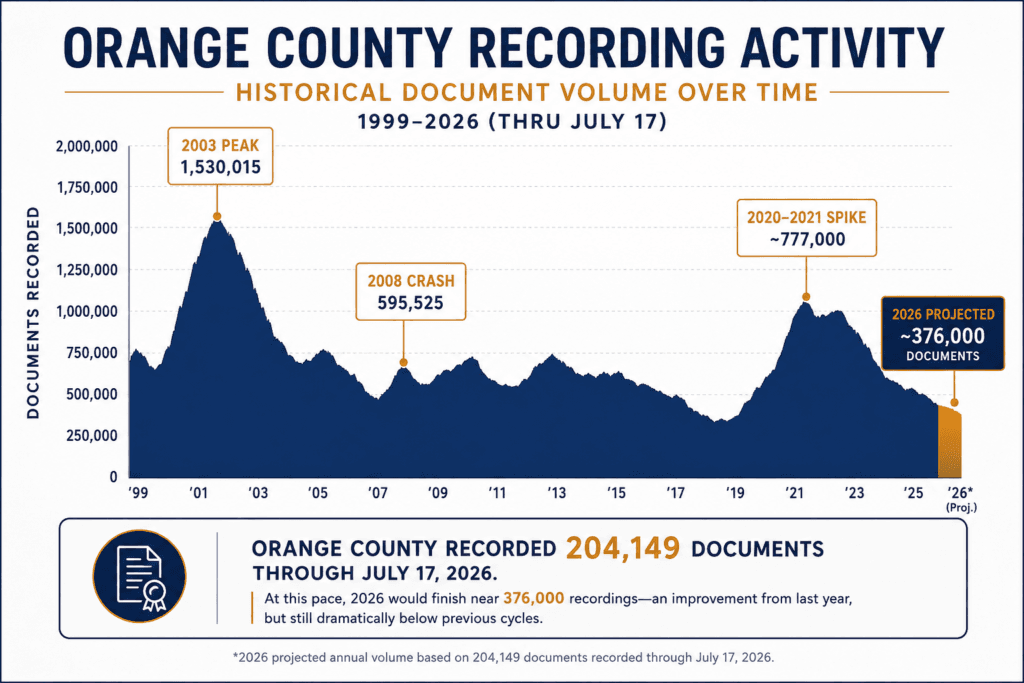
Through July 17, 2026, Orange County recorded approximately 204,149 documents.
At that pace, Orange County would finish the year at roughly 376,000 recorded documents.
That is an improvement from the recent slowdown, but it is still dramatically below what we have seen during previous real estate cycles.
For perspective, my historical recording data shows Orange County reached approximately:
That doesn’t mean every one of those documents represented a home sale.
Far from it.
But the trend tells us something about how much real estate activity is moving through the system.
And right now, there simply isn’t the same volume of transactions available that many real estate professionals became accustomed to during busier markets.
What Does “Recording Volume” Actually Measure?
This is where I think the number becomes more interesting.
The Orange County Clerk-Recorder handles documents affecting real property, including documents connected with changes in ownership and other property interests.
Recording activity can include things such as:
Sales and refinances
Grant deeds, deeds of trust and other documents associated with buying, selling and financing property.
Trust and ownership transfers
Deeds transferring property into or out of trusts, family transfers, quitclaim deeds and other changes in ownership.
Liens and reconveyances
Mortgages, releases, judgments, tax liens and reconveyances.
Easements and development documents
Rights-of-way, subdivisions, CC&Rs and documents related to development.
Probate and estate activity
Trustee deeds, affidavits, probate-related transfers and inherited-property transactions.
So when recording activity changes, we are seeing more than just a housing-sales statistic.
We are seeing a broader snapshot of what people are doing with real estate.
The Market Hasn’t Stopped. It Has Become More Specialized.
That is probably the biggest takeaway I have from the numbers.
There are fewer easy transactions.
And that changes where opportunity comes from.
For years, a strong market could create business simply because homeowners moved, refinanced, traded up or bought investment property.
Today, many homeowners have extremely low mortgage rates, substantial equity or both.Moving may mean giving up a favorable loan and replacing it with a considerably higher monthly payment.
For example, Freddie Mac reported the average 30-year fixed mortgage rate at 6.55% on July 16, 2026.
California sales have shown some improvement, but we're still operating in a relatively restrained environment.
C.A.R. reported June sales were up 6% from June 2025, while statewide sales remained below the 300,000 annualized level for the 45th straight month.
So where do transactions come from when fewer homeowners simply decide, “I think I’ll move”?
Increasingly, they come from life events.
Where May the Next Real Estate Transactions Come From?
1. Inherited and Trust-Owned Property
This is one of the biggest areas I'm watching.
Properties are constantly changing hands because someone passes away, a successor trustee steps in, beneficiaries inherit property or a family decides it no longer makes sense to keep a home.
These transactions can become complicated quickly.
Before a property can be sold, somebody may need to determine:
I've seen plenty of situations where everyone assumed the ownership was straightforward — until we looked at title.
Related: California Inherited Property Guide here
The earlier these questions are addressed, the better.
2. Aging Homeowners and Downsizing
Another major source of future inventory may simply be demographics.
Many longtime Southern California homeowners have owned their property for decades.
Their mortgage may be small or completely paid off.
Eventually, however, the house may become too large, stairs may become inconvenient, maintenance may become burdensome or the homeowner may want to move closer to family.
These aren't necessarily homeowners watching mortgage rates every Thursday.
They're making decisions based on life.
For Realtors, that means conversations about housing may increasingly begin long before someone says, “I'm ready to list.”
That's also one reason I believe neighborhood relationship-building matters so much.
A good circle prospecting strategy isn't about knocking on someone's door and immediately asking for a listing.
It's about becoming a familiar local resource long before that homeowner needs a Realtor.
3. Divorce, Marriage and Family Changes
Real estate frequently moves because families change.
Marriage.
Divorce.
Relocation.
Adding someone to title.
Removing someone from title.
Parents helping children.
Children helping parents.
These transactions can create both real estate opportunities and complicated title questions.
The deed someone signs today may affect what happens years from now.
That's one of the reasons I encourage agents to ask questions about ownership early rather than waiting until escrow is already open.
4. Financial Stress and Distressed Situations
Not every transaction comes from an exciting life event.
Sometimes people need to sell.
Job changes, debt, taxes, judgments, increased insurance costs and other financial pressures can all affect a homeowner's decision.
These are also the transactions where understanding title early can become especially important.
A seller may believe they have plenty of equity based on the mortgage balance — while additional liens, judgments or ownership issues tell a different story.
Finding those issues before an offer arrives gives everyone more time to solve them.
5. ADUs Are Creating New Property Decisions
Accessory Dwelling Units have changed the conversation around many California homes.
A homeowner may add an ADU for rental income.
A family may use one for aging parents.
An investor may see development potential.
A buyer may assign additional value to an existing unit.
And Realtors increasingly need to understand how permits, use, rental income and property configuration affect the sale.
ADUs aren't just changing backyards.
They're changing how people think about the utility and long-term value of a property.
Related: Backyard Revolution ADU article.
6. Vacant Properties Are Getting More Attention
Vacant properties can create another category of opportunity — and risk.
Cities are paying more attention to abandoned and poorly maintained properties.
The City of Orange, for example, has adopted a vacant-property ordinance requiring certain vacant properties to be registered and maintained.
That can create new responsibilities for owners and new considerations when those properties eventually sell.
Related: City of Orange Vacant Property Ordinance
Vacancy also creates another concern: fraud.
Vacant and free-and-clear properties have increasingly been targeted by criminals pretending to be the real owner.
That makes ownership verification more important than ever.
7. Investors May Begin Repositioning Assets
Investors don't necessarily need a booming market to transact.
Sometimes the opportunity comes from:
A quieter market can actually create opportunities for investors who have access to capital and are willing to look beyond traditional turnkey listings.
8. Development and Entitlement Activity
Some real estate activity never begins with a For Sale sign.
Lot splits.
Subdivisions.
Easements.
Development agreements.
New construction.
Land use changes.
Entitlement activity.
All of these can ultimately generate recorded documents and future real estate transactions.
Again, it reinforces the same idea:
MLS activity is only one part of the real estate ecosystem.
What Does This Mean for Realtors?
I don't think the answer is simply, “Prospect harder.”
I think the better strategy is to become more useful.
The professionals who understand complicated ownership situations will have an advantage in a market where more transactions involve trusts, inherited property, liens, family changes and unusual title situations.
That means learning to ask better questions.
Instead of only asking:
“Are you thinking about selling?”
You might ask:
“Has anything changed with the ownership of the property?”
“Is the property held in a trust?”
“Are multiple family members involved?”
“Has anyone passed away since title was last updated?”
“Would it help to review title before you begin preparing the home for market?”
Those conversations can uncover problems early.
And sometimes they uncover opportunities that haven't even become listings yet.
Why a Pre-Listing Title Review Matters More in This Market
One of the easiest ways to avoid surprises is to look at title before the property goes under contract.
A pre-listing title review can help identify things like:
Not every issue is difficult to fix.
But almost every issue is easier to address when you have time.
Once a buyer is in escrow, the clock starts running.
Loan contingencies matter.
Moving plans matter.
Rate locks matter.
Replacement purchases matter.
Suddenly, something that could have been handled calmly becomes an emergency.
That's exactly what I try to help prevent.
Related: Pre-Listing Title Review
The Opportunity Isn't Gone. It's Moving.
I don't know exactly when transaction volume will return to historical norms.
Nobody does.
But I don't think waiting for the market to suddenly become easy again is much of a strategy.
I'd rather understand where transactions are coming from now.
Inherited property.
Trust-owned property.
Life transitions.
ADUs.
Vacant properties.
Investors.
Complicated ownership situations.
Those transactions usually require more preparation, more communication and more expertise.
And in my opinion, that creates an opportunity for the professionals who are willing to connect the dots.
The market hasn't stopped. It has become more specialized.
And the people who understand that shift will be in a much better position when volume eventually returns.
Keeping Title Cool with AC,
Adrian Crandall
FAQ: Orange County Real Estate Recording Activity

ABOUT THE AUTHOR
About Adrian Crandall
Senior Sales Executive | Corinthian Title Company
Real estate is full of moving parts—and the best decisions happen when someone helps connect the dots.
For more than 25 years, I’ve helped Southern California Realtors, lenders, escrow professionals, attorneys, investors and homeowners navigate title issues, housing policy, market trends and the hidden details that can delay a closing.
Through The AC Current and my Connecting the Dots series, my goal is to help real estate professionals stay informed, protect their clients and remain one step ahead.
Questions about title, vesting, probate, fraud prevention or a transaction? I’m always happy to be a resource.

Continue Connecting the Dots
More practical insight on title, housing policy, fraud prevention and Southern California real estate.



Stay Ahead of Southern California Real Estate
Each month, The AC Current delivers practical insight on market conditions, title issues, housing policy, fraud prevention, property taxes, probate and trust transactions.
Get The AC CurrentHelping Southern California real estate professionals connect the dots before they become closing-day surprises.
Keeping Title Cool with AC
This information is provided for educational purposes only and is not intended as legal, tax or financial advice. Individual real estate and title situations vary.