

A recent Southern California real estate transaction is a reminder that one signature can put a homeowner's equity—and an entire home sale—at risk.
I've been in the title insurance business for more than 25 years.
You stay in real estate that long and you'll see some crazy things.
This is one of them.
California real estate scams and questionable practices come in all shapes and sizes, and homeowners don't always realize they're vulnerable until a transaction is already underway.
It happened recently in a transaction involving one of my clients.
A seller had listed her home with a Realtor.
A buyer made the winning offer. Escrow was open.
The buyer had completed the loan process and everyone was preparing to close.In fact, the buyer's loan had already funded.
Then, as part of the title company's final review before closing, an updated search of the public records was performed.
Something new had recorded against the property.
A Lis Pendens.
And suddenly, the transaction couldn't close.
What Happened?
Before the seller ever hired her Realtor, she had spoken with a real estate investment company about potentially selling her home.
According to the seller, she believed the company was going to provide her with a quote for what they would be willing to pay for the property.
She says she was told she needed to sign in order to receive the quote.
So she signed.
When she received the investor's proposed price, it was substantially below the home's market value.
She wasn't interested.
Rather than accept the lower price, she decided to hire a Realtor, properly market the property and see what buyers on the open market were willing to pay.
That decision worked.
Her Realtor marketed the home, multiple buyers had an opportunity to see it, and she ultimately accepted a considerably better offer.
From the seller's perspective, the earlier investor quote was behind her.
Except it wasn't.
What she believed she had signed in order to receive a quote was later being asserted by the investment company as a purchase agreement for her home.
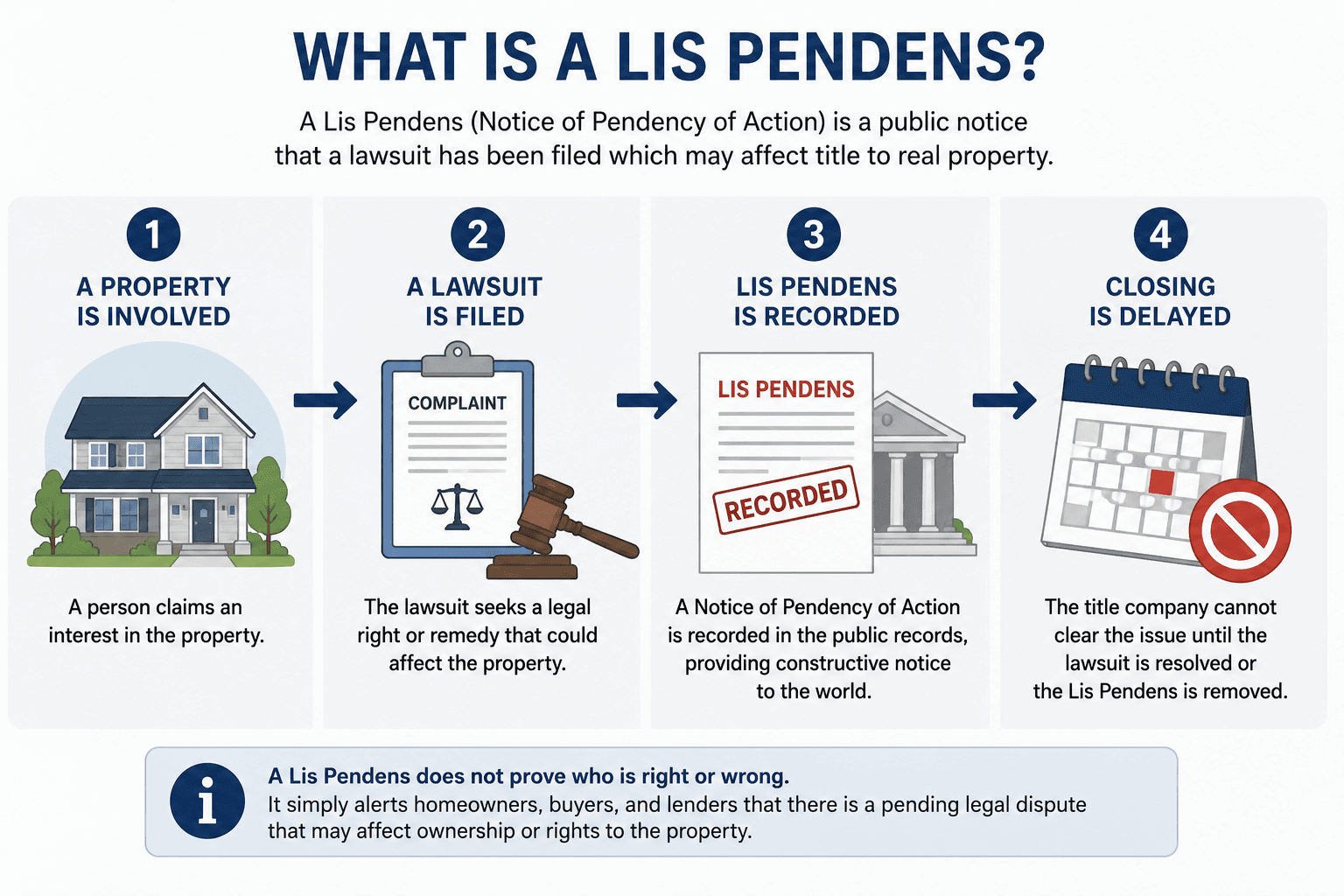
What Is a Lis Pendens?
A Lis Pendens, also called a Notice of Pendency of Action, is a notice recorded in the public records in connection with litigation involving a claim affecting real property.
In plain English, it puts the world on notice that there's a lawsuit involving a claimed interest in that property.
For someone trying to sell a house, that's a serious problem.
A title company can't simply see something like that in the public record and pretend it isn't there.
The matter has to be investigated and addressed before the title company can determine whether it can insure the new buyer's ownership.
In this transaction, the investment company was asserting rights involving the property based upon the agreement the seller had previously signed.
Now a transaction that everyone thought was about to close had a major title problem.
The Buyer's Loan Had Already Funded
This is the part that shows how quickly one problem can affect everyone in a real estate transaction.
The seller thought she was about to sell her home.
The buyer thought they were about to become the new owner.
The Realtors had negotiated the transaction.
Escrow was preparing to close.
The lender had completed the loan.
The buyer's money had already funded.
Then the Lis Pendens appeared.
Everything stopped.
And now everyone had to wait while the issue was investigated and resolved.
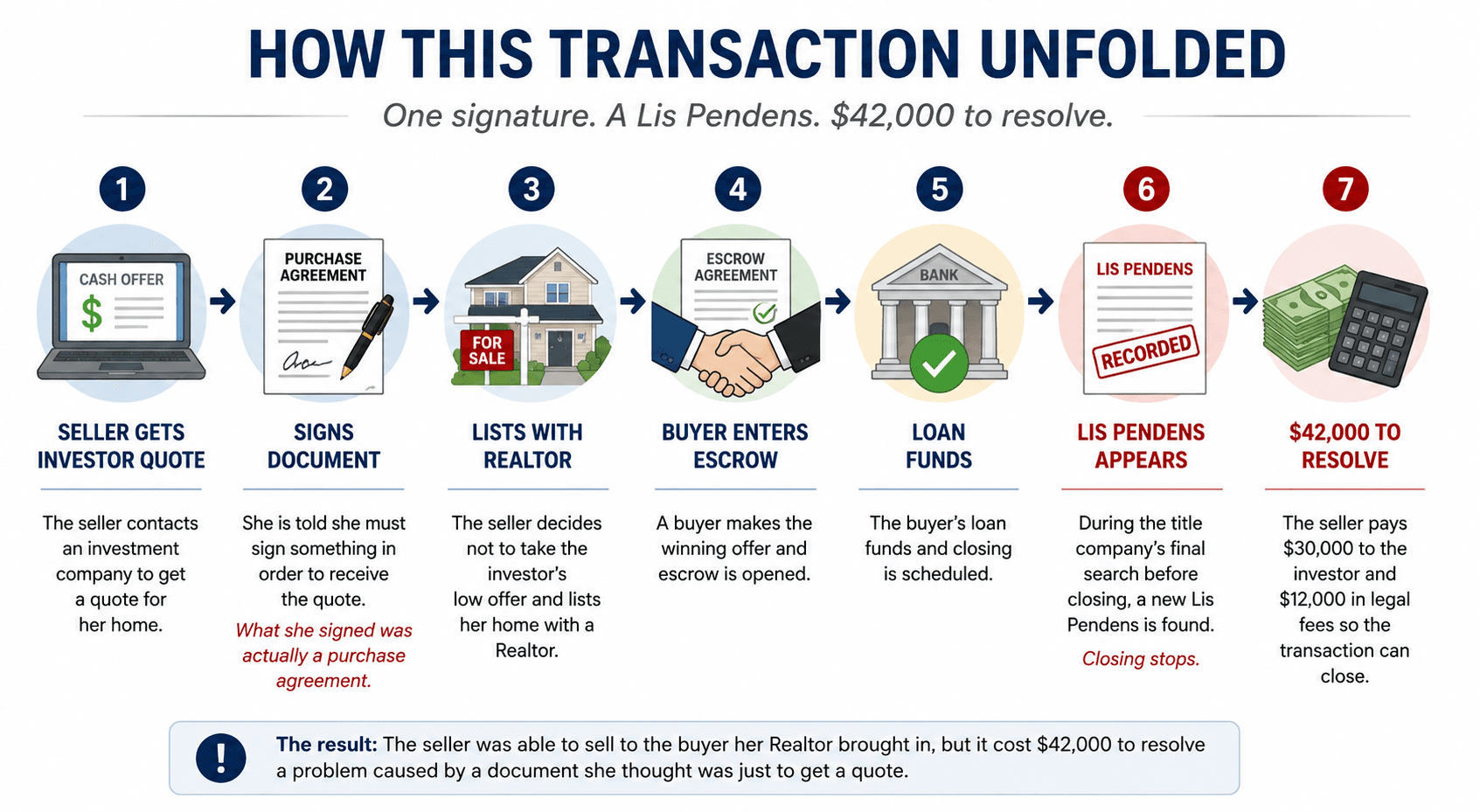
The Seller Ultimately Paid About $42,000
The seller still wanted to complete the transaction with the buyer her Realtor had brought to the property.
But the Lis Pendens and the dispute involving the earlier agreement had to be resolved first.
According to the information provided to me regarding the transaction, the seller ultimately paid approximately:
$30,000 to the investment company
plus approximately
$12,000 in legal fees
to resolve the matter and allow the transaction to close.
Approximately $42,000 total.
All because of a document she says she believed she was signing simply to receive a quote.
But even $42,000 doesn't tell the entire financial story.
The Seller Could Have Lost Even More
Remember why she didn't proceed with the investor in the first place.
Their proposed purchase price was substantially below market value.
Had the seller simply gone through with that transaction, she potentially would have given up considerably more equity by selling the property below what the open market was willing to pay.
That's why she hired a Realtor.
She exposed the property to the market and ultimately received a much better offer.
So think about the position she found herself in.
She could accept the investor's substantially below-market price and potentially leave a significant amount of her equity behind.
Or she could fight to complete the market-value sale and incur tens of thousands of dollars resolving the disputed agreement.
Neither is a good option.
And according to the seller, she never understood that she was agreeing to sell the property in the first place.
She thought she was getting a quote.
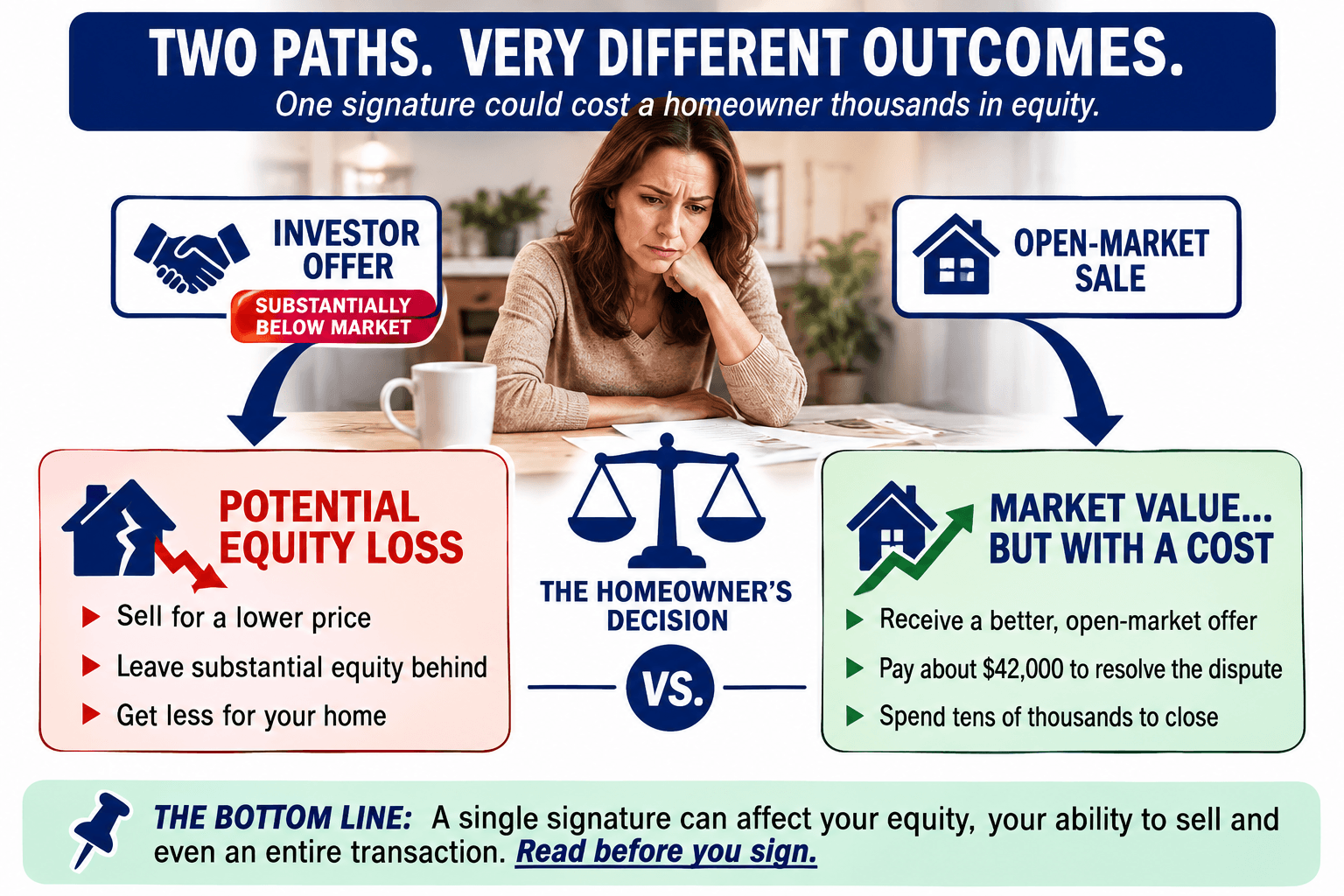
"Just Sign Here" Can Be a Very Expensive Sentence
That's probably the biggest consumer lesson from this story.
Don't rely solely on what someone tells you a document is.
Read what you're actually signing.
Someone may call something a quote, offer, proposal, estimate, benefit program or any number of other things.
What matters is what the document actually says.
If you're being asked to sign something involving your home, slow down.
Look for language such as:
If you don't understand what you're signing, don't sign it until you do.
Ask questions.Keep copies.
Have your Realtor review it.
And if you're potentially entering into a contract involving the ownership or sale of your home and you don't understand the legal consequences, consider having a qualified California real estate attorney review it.
An extra phone call is a lot less expensive than a $42,000 surprise.
Realtors: Ask Your Sellers One More Question
There's an important lesson here for Realtors, too.
When taking a listing, I think we need to get increasingly specific about what the homeowner may have done before calling us.
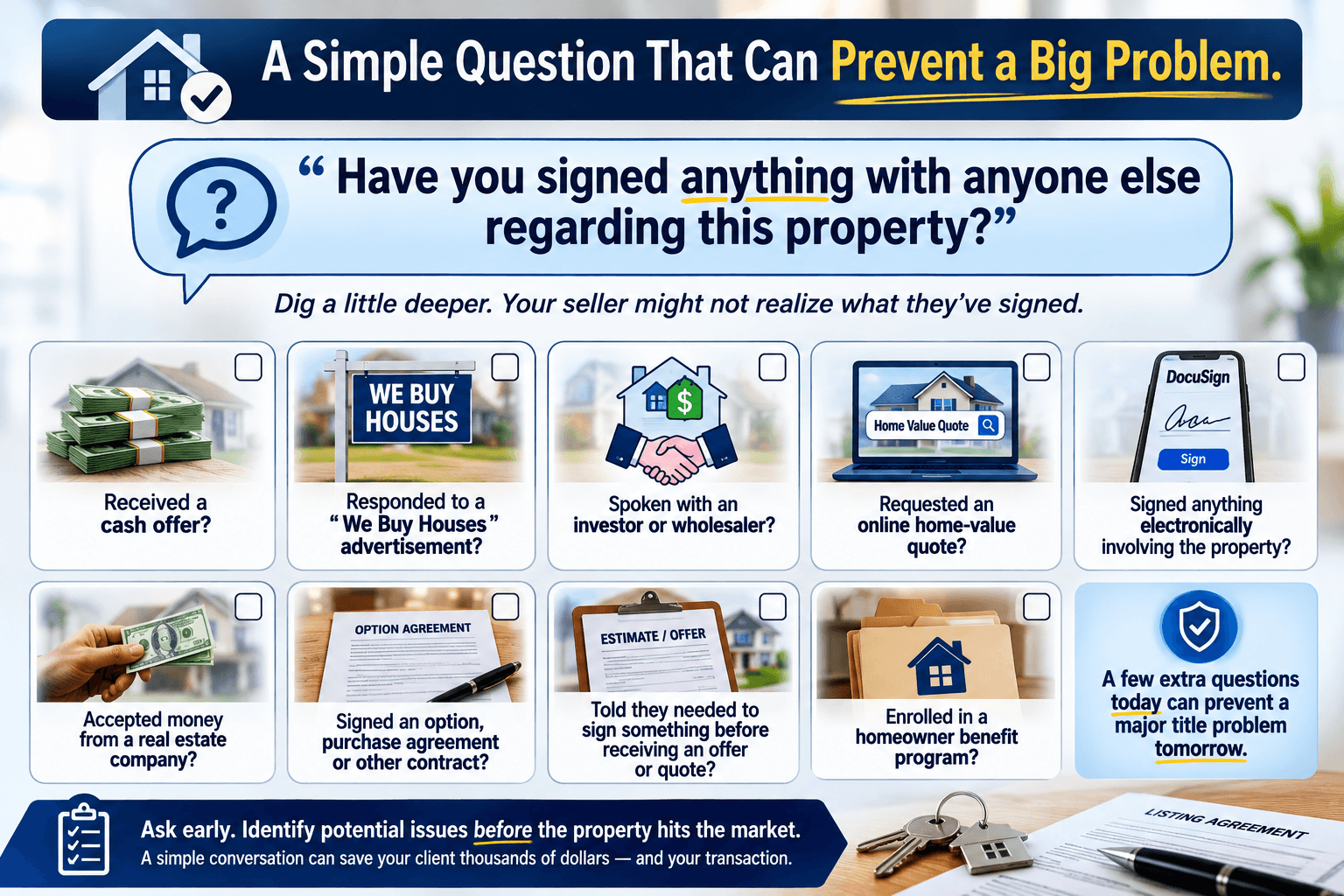
Don't just ask:"Is the property currently listed with anyone else?"
Ask:
"Have you signed anything with anyone else regarding this property?"
And then dig a little deeper.
Has the seller:
Your seller may sincerely answer "no" to the first question because they don't realize what they signed.
Ask the second question.
I'd much rather discover something unusual before the property hits the market than discover it after the buyer's loan has funded.
That's also one of the reasons I offer Realtors a Pre-Listing Title Review before problems become closing problems.
Why Did the Title Company Search the Property Again?
There's another lesson in this story that I think is worth explaining because it's one of those things title companies do behind the scenes that most consumers never think about.
A preliminary title report is based upon a search of the public records at a particular point in time.
But escrow might remain open for several weeks.
Things can happen during that time.
A judgment can record.
A lien can appear.
Another document can be recorded.
Or, as happened here, a Lis Pendens can suddenly show up.
That's why title companies perform updated searches—commonly called date-downs—as a transaction approaches recording.
In this case, the process worked exactly as it was supposed to.
The title company caught something that had appeared during escrow.
That's an important part of what happens behind the scenes in a real estate closing.
I've Seen Another Version of This Before
When I heard about this transaction, it immediately reminded me of something I encountered several years ago.
MV Realty and its "Homeowner Benefit Agreement."
The circumstances were different, but the underlying lesson stuck with me.
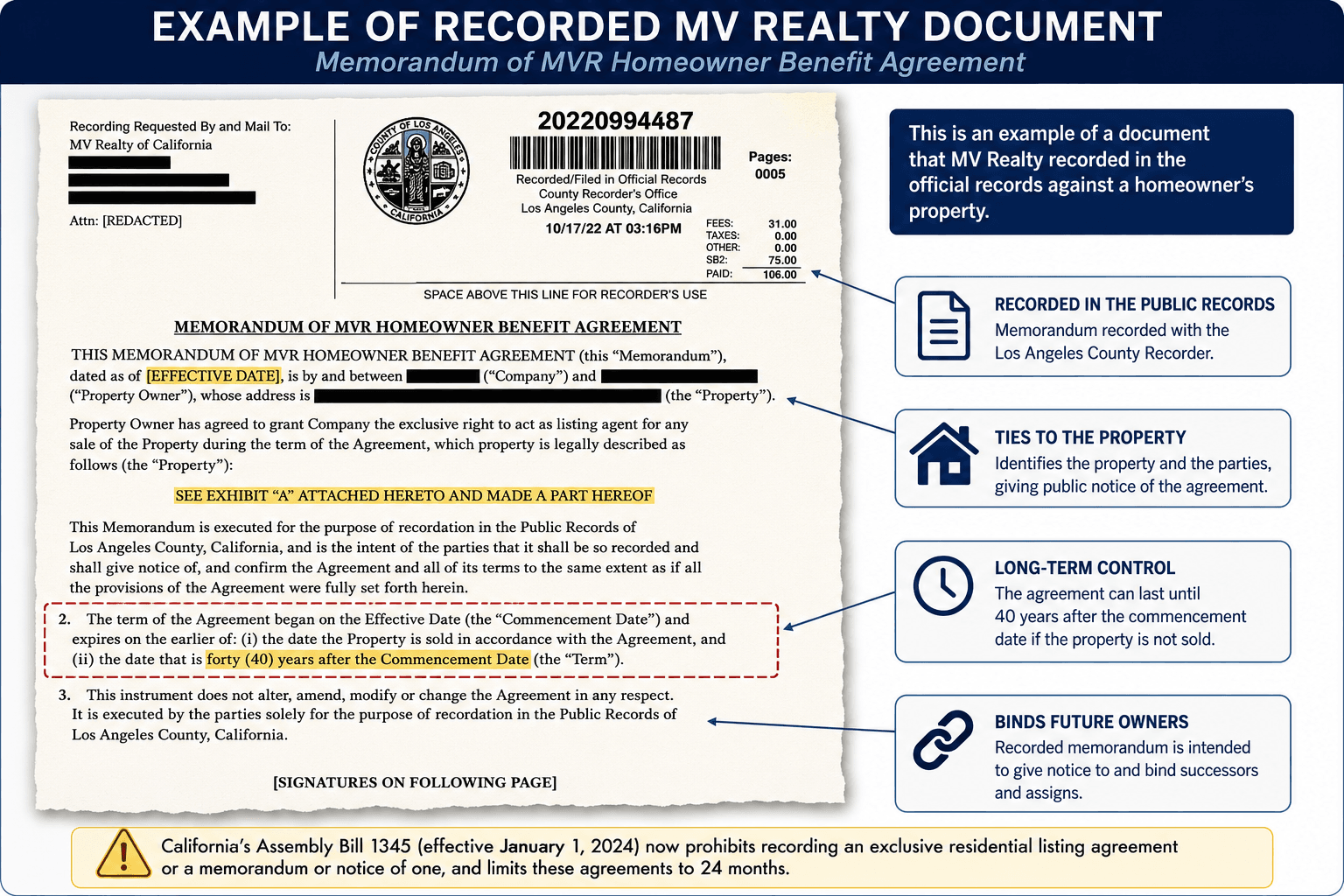
MV Realty offered homeowners an upfront payment in exchange for an agreement giving the company the exclusive right to act as their listing broker if they eventually decided to sell.
Then I saw one of the recorded documents.
And I remember thinking:
You've got to be kidding me.
The agreement could potentially remain in effect for 40 years.
A memorandum of the agreement could also be recorded in the public records against the property.
I've worked in title for a long time, and the idea that a homeowner could accept a relatively small benefit today and potentially affect their ability to freely sell their property decades into the future blew me away.
The State of California eventually took action against MV Realty.
According to the California Attorney General, nearly 1,500 California homeowners entered into these agreements.
The state alleged that the program used upfront payments to lock homeowners into 40-year exclusive listing agreements and recorded documents that could interfere with a future sale, refinance or transfer of the property.
California Attorney General — MV Realty enforcement action and settlement.
California also passed Assembly Bill 1345, the Residential Exclusive Listing Agreements Act.
The law generally limits residential exclusive listing agreements covered by the statute to 24 months, prohibits automatic renewal, limits qualifying written renewals to 12 months and makes it unlawful to record—or attempt to record—an exclusive listing agreement or a memorandum or notice of one with the county recorder.
California Legislative Information — AB 1345 / Civil Code §1670.12.
And in May 2026, the California Attorney General announced a settlement requiring MV Realty's California homeowner contracts to be voided, its recorded liens individually terminated, and restitution paid to consumers who had previously paid early termination fees.
Different Situation. Same Lesson.
I want to be very clear about something.
The MV Realty case and the transaction involving my client are not the same situation.
I'm not suggesting that they are.
But there's a reason one reminded me of the other.
In both situations, a homeowner's signature on a document had consequences involving one of their most valuable assets—their home.
That's the bigger lesson.
A document doesn't necessarily have to look scary to have serious consequences.
It might be presented as a "Homeowner Benefit."
It might be described as a "quote."
It might arrive through an electronic signature platform while you're sitting on your couch.
It might seem like a routine form.
But you're dealing with real estate.
And once a document creates contractual rights involving your property—or something gets recorded in the public records—the consequences can follow that property into a future sale or refinance.
California Real Estate Scams and Property Fraud Keep Changing
I've previously written about [seller impersonation fraud in California real estate], where someone pretends to be the owner of property they don't actually own.
[INTERNAL LINK: Seller Impersonation Fraud article.]
That's completely different from what happened here.
But it's another example of how vulnerabilities in real estate continue to evolve.
Wire fraud.
Seller impersonation.
Vacant-land fraud.
Forged deeds.
Fraudulent liens.
Misleading contracts.
Questionable solicitations.
The methods change.
The target doesn't.
Your home may represent hundreds of thousands—or millions—of dollars of your accumulated wealth.
That makes real estate an attractive target.
And sometimes protecting yourself isn't particularly complicated.
Slow down.
Verify.
Ask questions.
Read before you sign.
And surround yourself with professionals who aren't afraid to say, "Something doesn't look right here."
How Can Homeowners Protect Themselves?
If you're considering selling your home—or even just requesting an offer for it—there are a few habits worth developing.
Read before you sign.
Don't allow someone to rush you because a document is supposedly "just a quote.
"Understand what you're agreeing to.
If you're unsure, ask specifically whether the document creates any obligation to sell, list or otherwise encumber your property.
Know what your property may actually be worth.
A fast cash offer may provide convenience, but understand what you're giving up in exchange for that convenience.
Keep copies of everything.
If you later decide to hire a Realtor, show them anything you've previously signed involving the property.
Check before assuming something is harmless.
If you don't understand a document, get professional advice before signing it—not after.
Realtors: Protection Is Part of the Job
For Realtors, I think our industry has to recognize that protecting a client today goes beyond negotiating price, managing inspections and getting through escrow.
Sometimes it's recognizing a vulnerability the client didn't know existed.
Ask better questions.
Find out what happened with the property before you became involved.
Pay attention when something doesn't make sense.
And surround yourself with escrow, lending and title partners who will do the same.
That's a big part of how I approach my role at Corinthian Title.
I don't want to simply receive your title order and wait for closing.
I want to be someone you can call before there's a problem.
If your seller has signed something unusual, let's look at it.
If there's a strange document in the public record, let's investigate it.
If your seller has a complicated title situation, let's talk about it.
And if you're simply not sure whether something matters, call me.
Sometimes we'll look at it and discover everything is fine.
Other times, we may find the issue that saves your client tens of thousands of dollars—or saves the transaction altogether.
The Bottom Line
This seller ultimately got her home sold.
But it cost approximately $42,000 to resolve a problem involving a document she says she believed she was signing simply to receive a quote.
Had she instead sold to the investor at the substantially below-market price, the financial loss potentially could have been even greater.
That's an expensive lesson.But it's one worth sharing.
After more than 25 years in title insurance, I've learned that the methods change, the paperwork changes and the pitch changes.
But one thing remains the same: your home is too important an asset to be casual about what you sign.
A single signature can affect your equity, your ability to sell, and sometimes an entire transaction.
Pay attention to what you're signing.
Ask questions.
And make sure you understand exactly what you're agreeing to before your signature becomes somebody else's leverage.
And Realtors, have these conversations with your clients.
Because sometimes the best title problem is the one we identify before it ever becomes a title problem.
Keeping Title Cool. Closing with Confidence.
This article is provided for general educational purposes and describes circumstances reported to me regarding a real estate transaction. Certain identifying details have been omitted to protect the parties involved. Nothing in this article is intended as a legal determination regarding the validity or enforceability of any agreement or the conduct of any person or company. It is not legal advice. Anyone involved in a contractual dispute, Lis Pendens or other legal matter involving real property should consult a qualified California real estate attorney.

ABOUT THE AUTHOR
About Adrian Crandall
Senior Sales Executive | Corinthian Title Company
Real estate is full of moving parts—and the best decisions happen when someone helps connect the dots.
For more than 25 years, I’ve helped Southern California Realtors, lenders, escrow professionals, attorneys, investors and homeowners navigate title issues, housing policy, market trends and the hidden details that can delay a closing.
Through The AC Current and my Connecting the Dots series, my goal is to help real estate professionals stay informed, protect their clients and remain one step ahead.
Questions about title, vesting, probate, fraud prevention or a transaction? I’m always happy to be a resource.

Continue Connecting the Dots
More practical insight on title, housing policy, fraud prevention and Southern California real estate.



Stay Ahead of Southern California Real Estate
Each month, The AC Current delivers practical insight on market conditions, title issues, housing policy, fraud prevention, property taxes, probate and trust transactions.
Get The AC Current