

How circle prospecting can turn one real estate listing into relationships with 20–30 nearby homeowners—and eventually your next listing.
I go to a lot of open houses. And one thing I've learned is that there's a huge difference between simply holding an open house and using it as part of a circle prospecting strategy.
As a title rep, open houses are one of my favorite ways to meet Realtors I might not otherwise have an opportunity to spend time with. And after visiting enough of them, I've noticed something interesting:
There is a HUGE difference in how Realtors show up at their open houses.
I've walked into open houses where the Realtor immediately stands up, smiles, introduces themselves and genuinely seems happy that someone walked through the door.
I've also walked into homes where the agent barely looks up from their laptop.
"Feel free to look around."
I've seen pen-and-paper sign-in sheets sitting on kitchen counters and sophisticated digital registration systems on iPads.
I've met agents who can tell you seemingly everything about the house, the neighborhood and the local market.
And I've met others who seem to know little more than the combination to the lockbox.
Some are engaging.
Some are watching television.
Some seem excited to have visitors.
Others make you wonder whether you're inconveniencing them by showing up.
And I can't help but think:
If I were a homeowner quietly evaluating this Realtor, what impression would I leave with?
Because there's something Realtors may occasionally forget about an open house.
The house isn't the only thing on display.
So are you.
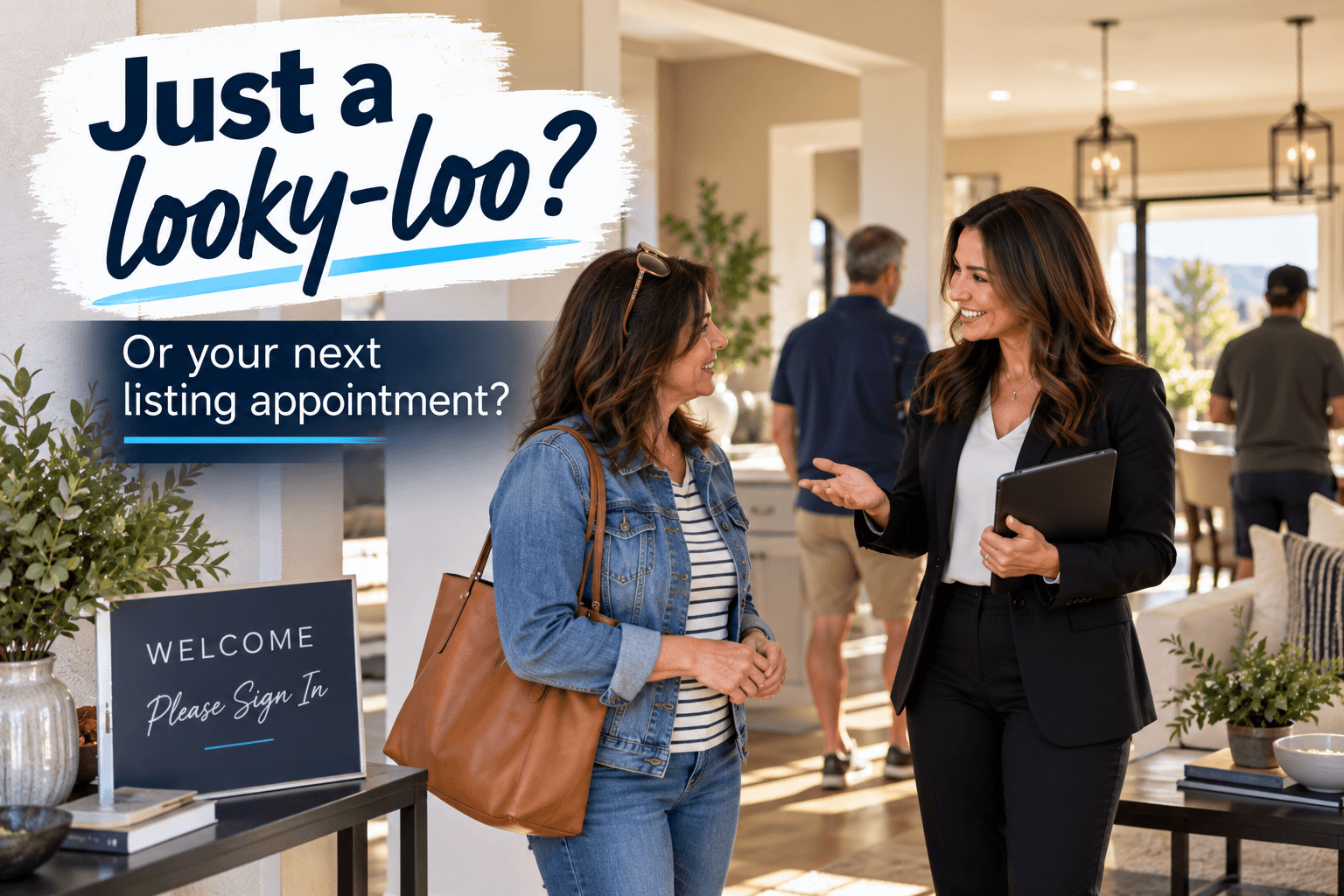
"We Didn't Really Have Any Visitors. Just Some Looky-Loos."
I've heard some variation of this more times than I can count."
The open house wasn't very busy."
"We mostly had neighbors."
Or one of my favorites:
"Just a bunch of looky-loos."
But let's think about those "looky-loos" for a minute.
If someone owns a house six doors down from your listing, they're not necessarily an unwanted visitor.
They may be one of the most valuable people who walks through the door all weekend.
They already own real estate in the exact neighborhood where you're trying to build your business.
They probably know other homeowners there.
They're naturally curious about what homes are selling for.
And at some point, they're going to sell too.
Here's the important part:
They're probably not going to walk through your door and announce:
"Hi! I'm thinking about selling my house next spring, and I'm secretly here to determine whether you're one of the Realtors I should interview."
They're going to say:
"We're neighbors. We just wanted to see the house."
And then they're going to look around.
But they may also be looking at you.
Did you stand up and greet them?
Did you remember their name?
Do you seem knowledgeable?
Do you know what's happening in the neighborhood?
Does the home appear to be marketed professionally?
Are you attentive?
Do you seem genuinely excited about your listing?Do you listen?
Are you someone they could picture trusting with one of their largest financial assets?
You may never know you're being interviewed.
And you might not even make it to the actual interview.
Circle Prospecting Starts Before the Open House
This is where one of the oldest Realtor prospecting strategies becomes incredibly powerful.
Circle prospecting.
The idea is simple.
Every time you take a listing, use a property-data platform such as Corinthian Title Toolbox or TitlePro247 to identify the surrounding homeowners. Begin building your neighborhood list and introduce yourself.
Personally, I like starting with the closest 20–30 homes.
If your listing hits the market Wednesday or Thursday, spend some time before the weekend knocking those doors.
Not to ask for their listing.
Not to give them a sales pitch.
Simply introduce yourself.
Something like:
"Hi, I'm Adrian. I'm the Realtor who just listed the home down the street. Sorry to bother you—I wanted to introduce myself and let you know what's happening. If you notice any unusual activity around the property or have any questions, I'm the person to call. We're also having an open house this weekend, and I'd love for you to stop by, grab a donut and say hello."
That's it.
You now have a legitimate reason to introduce yourself to 20 or 30 homeowners.
Better yet, you've invited them into your showroom.
Of course, the best neighborhood marketing campaign starts with a listing that's actually ready to sell.
Before launch, I also recommend agents address potential ownership, lien or vesting issues through a Pre-Listing Title Review rather than discovering them after a buyer is already involved.
Your Listing Is Your Showroom
Think about how powerful that is.
Instead of telling a homeowner how you would market their property someday, you're allowing them to watch you do it today.
They see your signs.
They see your marketing.
They see your photography.
They see your flyers.
They see how the property is presented.
They see your open house.
And when they walk through the door, they see you.
That's why your energy at an open house matters.
If you're going to spend Thursday introducing yourself to the neighborhood and inviting everyone to come see your listing Saturday, the last thing you want them to see when they arrive is you sitting on the couch staring at your phone.
If you're going to spend the week getting the neighborhood to walk through the door, make sure they like what they see when they get there.
Your open house isn't simply an opportunity to find a buyer.
It's an audition for your next seller.
Stop Treating the Neighbors Like Looky-Loos
Neighbors are curious.Let them be.Actually, encourage it.
Instead of thinking:
"Great. Another neighbor who isn't buying the house."
Try:
"Great. Another homeowner in the neighborhood just walked into my business."
Then have a conversation.
"You're a neighbor? Great! What street are you on?"
"How long have you lived here?"
"What do you love about the neighborhood?"
"Have you seen what the sellers did with the kitchen?"
Or one of my favorites:
"I'm curious—what did you think this one was going to be listed for?"
Now we're talking about real estate without asking:
"So...are you thinking about selling?"
There's plenty of time for that conversation later.
Right now, your objective is much simpler.
Make an impression worth remembering.
Turn One Listing Into a Simple Neighborhood Marketing System
Here's where circle prospecting gets interesting.
The open house shouldn't be the end of the strategy.
It should be one step in a very simple system.
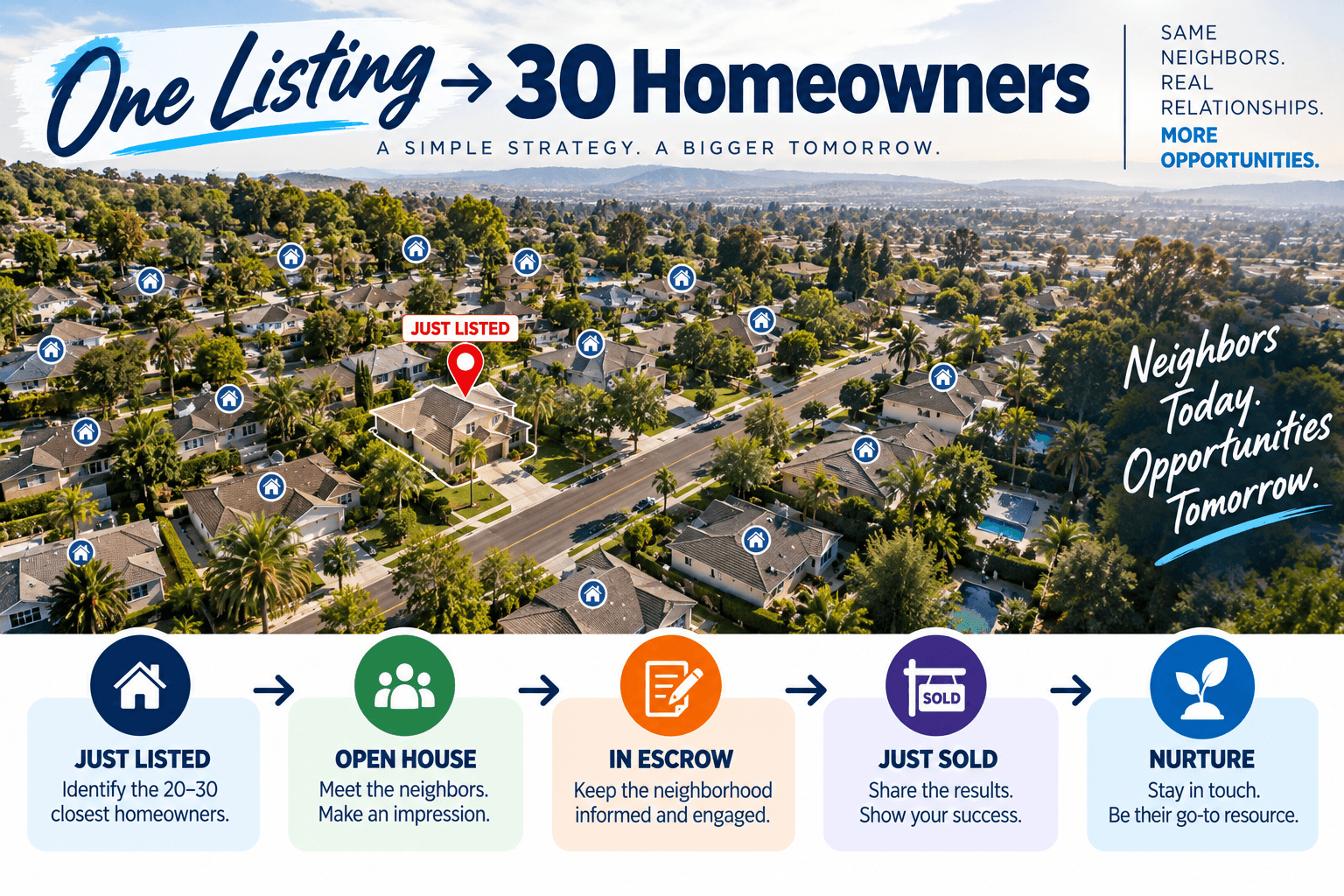
Touch #1 — Just Listed
Identify the closest 20–30 homeowners.
Introduce yourself personally whenever possible.
Let them know about the listing and invite them to the open house.
You can supplement the door knock with a postcard, neighborhood flyer or other marketing, but I wouldn't eliminate the personal interaction.
Technology should make prospecting easier.
It shouldn't replace the relationship.
The Open House — Your Audition
Now those homeowners have an opportunity to see how you operate.
Stand up.
Smile.
Know your listing.
Know your neighborhood.
Have conversations.
Be curious.
And please don't treat the neighbor who walked three houses over like they're wasting your time.
They may not need a Realtor today.
But they might be deciding whether you're worth remembering tomorrow.
Touch #2 — We Opened Escrow
Once the property goes under contract, you have another legitimate reason to communicate.
"Quick neighborhood update—the home we listed down the street received an offer the sellers accepted, and we've opened escrow. If you know someone who was interested in the property, they're still welcome to contact me about backup opportunities or other homes coming available nearby."
Notice what you're doing.
You're not asking them for business.
You're demonstrating business.
Touch #3 — We Closed
Now finish the story.
"We officially closed on the home down the street. If you see the new owners moving in, stop by and introduce yourself. Some of those first conversations have a funny way of turning into longtime neighborhood friendships."
Then—and only then—earn the right to make the soft ask.
"By the way, if you or one of your neighbors ever has questions about what selling might look like in today's market, I'm always happy to be a resource."
Simple.
Twenty to thirty homeowners.
One listing.
Three legitimate reasons to communicate.
And one opportunity to demonstrate your ability in between.
How to Circle Prospect Around a New Listing
Wednesday/Thursday — Just Listed:
Pull the closest 20–30 homeowners, knock the doors and personally invite them to the weekend open house.
Saturday/Sunday — Open House:
Treat every neighbor as a potential future relationship. Capture their information when appropriate and make notes afterward.
When You Open Escrow:
Give those homeowners a quick neighborhood update.
After Closing:
Share the result, welcome the new neighbors and remind homeowners you're available if they ever have questions.
Long Term:
Move those contacts into your CRM and continue providing neighborhood-specific information.
The Data Makes This Much Easier Than It Used to Be
Years ago, building these neighborhood lists could take considerable time.
Today, Realtors have access to property-data tools that make identifying and organizing homeowners considerably easier.
For example, Corinthian Title clients can use Title Toolbox, a map-based property research and farming platform that allows Realtors to identify surrounding properties and review ownership information, mailing addresses, mortgage and transfer history, sales comparables and nearby neighbors. The platform can also export farm information into Excel or PDF for continued marketing.
Another resource available is TitlePro247, which provides property data and analytics, property profiles, sales and mortgage information, comparable sales and neighborhood information.
These aren't just "property profile" tools.
Used strategically, they can become prospecting tools.
Pull the immediate neighbors.
Build your list.
Track who you've met.
Document who attended the open house.
Record conversations and follow-up opportunities in your CRM.
And when your next listing comes up three streets away?
Do it again.
How Circle Prospecting Becomes Geographic Farming
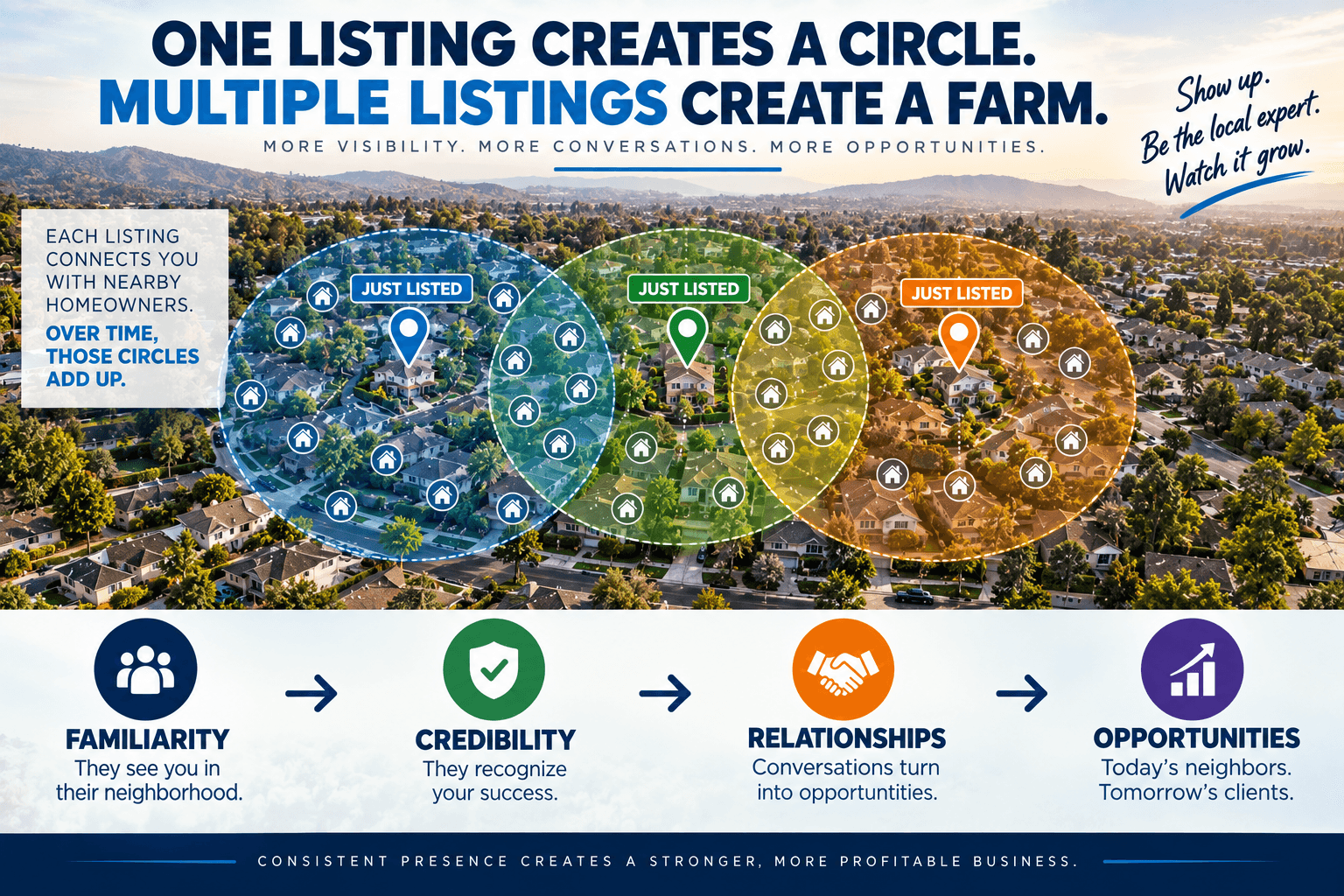
Let's imagine you take one listing and introduce yourself to 30 surrounding homeowners.
Thirty names go into your database.
A few months later, you list another property nearby.
Another 30.
There's some overlap.
That's a good thing.
Some homeowners have now seen your name twice.
Then another listing appears.
You do it again.
Now certain homeowners have watched you list, market and sell two or three properties in their neighborhood.
Eventually you're no longer:
"That Realtor who knocked on our door."
You're:
"That Realtor who keeps selling homes around here."
That's a completely different position to occupy in someone's mind.
And this is where agents sometimes misunderstand geographic farming.
The goal isn't necessarily to knock on someone's door Thursday and get their listing Friday.
The objective is to accumulate evidence of your competence in front of the same group of homeowners over time.
Every listing becomes another piece of evidence.
Every introduction builds familiarity.
Every open house demonstrates professionalism.
Every escrow demonstrates activity.
Every closing demonstrates results.
Every thoughtful follow-up demonstrates consistency.
Over several years, those 20–30 homeowner groups begin overlapping into something much more valuable:
A database of homeowners who have actually watched you perform.
Give Them a Reason to Keep Hearing From You
Staying in touch doesn't mean continually asking whether someone is ready to sell.
Share information that actually matters to homeowners—changes in the Southern California real estate market, insights about housing affordability, information about how ADUs can affect a property's utility and value, or warnings about real estate fraud targeting homeowners.
Now your database isn't simply receiving marketing. You're giving people reasons to remember you as a useful real estate resource.
Don't Let Technology Get in the Way of the Relationship
Technology can absolutely make this strategy more efficient.
Use property data to identify homeowners.
Use your CRM to track them.
Use automated reminders so people don't fall through the cracks.
Use digital registration at your open houses if it makes the experience easier.
Use email, social media and appropriate digital marketing to reinforce your presence.
But don't automate away the most important part.
You.
There's a difference between someone receiving your Just Sold postcard and someone saying:
"Oh yeah, I met her when she sold the Johnsons' house."
There's a difference between seeing an Instagram ad and remembering:
"He was the Realtor who spent 10 minutes talking with us at that open house."
Real estate is still an extraordinarily relationship-driven business.
The technology should help you create more opportunities for those relationships—not eliminate them.
Put This Strategy Into Action
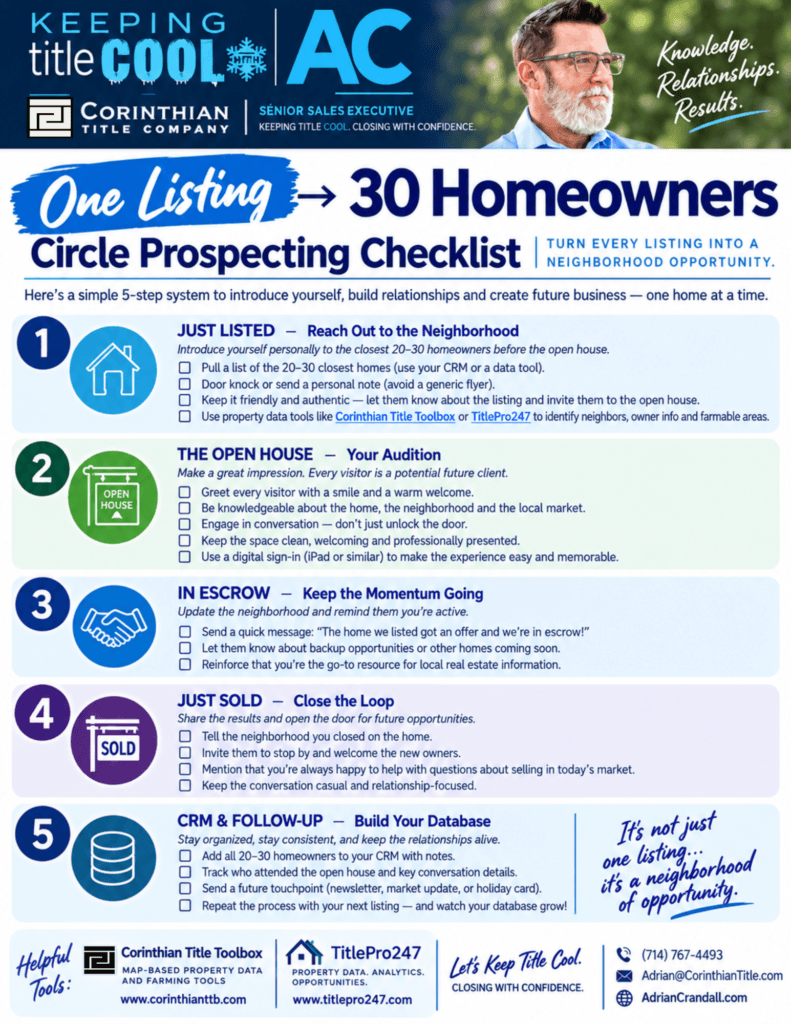
One Listing → 30 Homeowners
Free Download
Keep it with your listing marketing plan and use it every time you take a new listing.
One Listing Can Be Worth Much More Than One Closing
When a Realtor earns a listing, the obvious objective is to sell that property and represent the client exceptionally well.
But that listing also gives you something else.
Permission to market locally.
There's a sign in the yard with your name on it.
There's activity in the neighborhood.
People are curious.
Neighbors want to know the price.
They want to see inside.
They want to know how many offers you received.
And eventually they're going to want to know what the sale means for the value of their house.
That's an incredible marketing opportunity.
Don't waste it.
Circle the neighborhood.
Introduce yourself.
Invite the "looky-loos."
Put on a fantastic open house.
Keep the neighborhood informed.
Stay in touch.
Then do it again on the next listing.
Because the person wandering through your open house this Saturday who seems like they're "just looking" may be doing something completely different.
They may be deciding whether you'll get the opportunity to sell their house next.
And they probably won't tell you they're watching.

ABOUT THE AUTHOR
About Adrian Crandall
Senior Sales Executive | Corinthian Title Company
Real estate is full of moving parts—and the best decisions happen when someone helps connect the dots.
For more than 25 years, I’ve helped Southern California Realtors, lenders, escrow professionals, attorneys, investors and homeowners navigate title issues, housing policy, market trends and the hidden details that can delay a closing.
Through The AC Current and my Connecting the Dots series, my goal is to help real estate professionals stay informed, protect their clients and remain one step ahead.
Questions about title, vesting, probate, fraud prevention or a transaction? I’m always happy to be a resource.

Continue Connecting the Dots
More practical insight on title, housing policy, fraud prevention and Southern California real estate.



Stay Ahead of Southern California Real Estate
Each month, The AC Current delivers practical insight on market conditions, title issues, housing policy, fraud prevention, property taxes, probate and trust transactions.
Get The AC Current