
I've received this call more times than I can remember.
A Realtor I work with calls me, clearly concerned, because a past buyer just received a property tax bill they weren't expecting.
Sometimes it's a few thousand dollars. Sometimes it's enough that the buyer is understandably a little panicked.
And the questions start coming quickly:
"Isn't the seller responsible for this?"
"Didn't we already take care of the property taxes in escrow?"
"Why is my buyer being charged so much?"
"Their taxes are impounded. Isn't the lender supposed to pay this?"
And occasionally:
"Did somebody mess up?"
Usually, nobody messed up.
What the buyer has received is a California supplemental property tax bill, and it's one of those parts of buying California real estate that makes perfect sense once someone explains it—but can look pretty alarming when an unexpected bill shows up months after closing.
So let's make sense of it.
First: No, this usually isn't the seller's tax bill
This is probably the biggest misconception I hear.
At closing, buyers and sellers typically see property taxes prorated through escrow. So when the buyer receives another tax bill later, it's natural to wonder whether they're somehow being asked to pay taxes that belonged to the seller.
That's generally not what's happening.
The seller is responsible for their applicable share of the regular property taxes during their ownership.
The supplemental assessment is different.
It's generally created because the buyer's acquisition caused the property to be reassessed.
Here's a simple example that makes this much easier to understand.
Imagine a seller bought their house many years ago and, because of Proposition 13, the property's current taxable value is only:
$500,000
Your buyer purchases the home for:
$900,000
The county now has a property that was being taxed based on a $500,000 assessed value but has experienced a reassessable change in ownership and receives a new value of $900,000.
There's a $400,000 gap.
That's what the supplemental assessment is addressing.
New assessed value: $900,000
Previous assessed value: $500,000
Net supplemental assessment: $400,000
The seller didn't create that $400,000 increase.
The change in ownership did.
That's why the buyer is receiving the supplemental assessment rather than the seller.
California's supplemental assessment system is designed to account for changes in taxable value caused by reassessable changes in ownership and completed new construction.

"But didn't we already prorate the taxes in escrow?"
Yes.
And that's where the confusion gets even more understandable.
The tax proration you see on a closing statement and the supplemental assessment aren't necessarily addressing the same thing.
At the time of closing, the regular tax bill may still be based on the seller's existing assessed value.
Go back to our example.
If the county's current tax roll still has the property assessed at $500,000, that's the existing tax obligation being dealt with during escrow.
But your buyer just acquired a $900,000 property.
The county doesn't instantly rewrite the regular tax bill the moment the grant deed records.
California uses the supplemental assessment system to catch up the difference.
That's why I think the easiest way to explain a supplemental tax bill is this:
It's a catch-up bill.
The property's taxable value changed in the middle of a property tax cycle, and the county is catching up the taxes attributable to that change.
That's much easier to understand than all of the government terminology surrounding supplemental assessments.
Why can the bill seem so ridiculously high?
This is usually the next question.
And again, put yourself in the buyer's shoes.
Maybe they're already paying $6,000, $8,000, $10,000 or considerably more per year in property taxes. Those taxes may even be built into their monthly mortgage payment.
Then an envelope arrives asking for several thousand dollars more.
Of course they're going to think something is wrong.
But consider what happens when there's a large difference between the seller's taxable value and the buyer's new value.
If someone has owned a Southern California home for 20 or 30 years, their Proposition 13 taxable value can be dramatically lower than the price the home sells for today.
The larger that gap is, the larger the supplemental assessment can be.
Using our example:
New assessed value: $900,000
Previous assessed value: $500,000
Difference: $400,000
For illustration, if we used a hypothetical property tax rate of 1.1%, a full year of additional tax associated with that $400,000 difference would be approximately:
$4,400
Now imagine the prior assessed value wasn't $500,000.
Imagine it was $300,000.
Or $250,000.
You can quickly see why a buyer opening that envelope might be shocked.
But there's another important piece.
The county doesn't necessarily charge a full year's tax on that difference.
The supplemental tax is prorated based on when the reassessable event occurred. California law applies a proration factor based on the portion of the tax year remaining.

So what exactly is the supplemental tax paying for?
California's property tax fiscal year runs from July 1 through June 30.
Homes obviously don't all sell on July 1.
Let's say you purchase a home during the middle of the fiscal year.
The property has been taxed based on its previous assessed value, but your purchase creates a new base-year value.
The supplemental assessment essentially fills in the difference for the appropriate portion of the fiscal year after that reassessable event.
Under California law, the change is generally treated as occurring on the first day of the month following the change in ownership for purposes of calculating the remaining portion of the tax year.
That's why the date of the sale matters.
And it's also where we get one of the strangest parts of California's supplemental tax system.
Yes, your buyer can receive TWO supplemental assessments
I can imagine the second phone call:
"Adrian, remember that supplemental tax bill we talked about? They just got ANOTHER ONE."
That can be completely legitimate too.
If a reassessable change in ownership occurs between June 1 and December 31, there is generally one supplemental assessment covering the appropriate portion of that fiscal year.
If it occurs between January 1 and May 31, there are generally two supplemental assessments.
Why?
Because the reassessment affects two fiscal years.
One covers the remaining portion of the current fiscal year through June 30.
The other accounts for the following fiscal year.
So receiving two notices or bills doesn't automatically mean somebody accidentally hit "print" twice.
The timing of the purchase can create two legitimate supplemental assessments. California county guidance consistently reflects this one-versus-two-assessment structure.

"Okay, but their taxes are impounded. Won't the lender pay this?"
This is probably the most dangerous assumption in the whole process.
A buyer sees property taxes included in their monthly mortgage payment and reasonably thinks:
"Great. My lender handles my taxes."
Usually they're thinking about the regular secured property tax bill.
Supplemental bills are different.
California's Preliminary Change of Ownership Report actually contains a warning to purchasers explaining that supplemental assessments aren't paid by the title or escrow company at closing and aren't included in lender impound accounts.
So when one arrives, don't toss it into the mortgage paperwork pile and assume somebody else is taking care of it.
I'd tell the homeowner to contact their mortgage servicer and ask.
Verify. Don't assume.
Orange County homeowners can also review the Treasurer-Tax Collector's Supplemental Property Tax FAQ for information about supplemental bills and payment.

And why didn't title or escrow warn us what the amount would be?
Here's another important distinction.
The title company doesn't establish the new assessed value.
Escrow doesn't establish it either.
The County Assessor does.
In fact, the state's own change-of-ownership paperwork warns that the property acquired may be subject to a supplemental assessment in an amount to be determined by the County Assessor.
That's important.
At closing, we don't necessarily have the final supplemental assessment sitting in front of us waiting to be collected.
The reassessment process happens through the county after the change in ownership.
That's one reason the bill can arrive well after everyone has celebrated the closing and moved on.
Could the county ever owe YOU money?
Here's the part nobody panics about.
A supplemental assessment can go the other direction.
If the property's newly established assessed value is lower than its previous taxable value, the result can be a negative supplemental assessment.
In that situation, there can be a supplemental refund rather than additional tax. California county guidance expressly recognizes negative supplemental assessments and refunds.
That doesn't happen in the typical example people call me about, but it's useful because it reinforces what a supplemental assessment actually is.
It's not an automatic "new homeowner tax."
It's an adjustment to taxable value.
Sometimes the adjustment goes up.
Sometimes it goes down.
What if the buyer thinks the county got the value wrong?
That's when I wouldn't wait.
The Notice of Supplemental Assessment tells the homeowner the new assessed value being used.
If that value looks wrong, the homeowner should contact the County Assessor and look into the applicable review or appeal process.
Those deadlines matter.
For my Orange County clients, I'd start with the Orange County Assessor. For a property elsewhere in California, go directly to that county's Assessor.
The important thing is not to wait until the tax bill becomes delinquent before asking why the assessment looks wrong.
This isn't limited to home sales
Changes in ownership are probably the version Realtors will encounter most often, but supplemental assessments can also result from qualifying new construction.
An addition, pool or significant improvement can potentially create additional assessed value.
Normal maintenance and repairs are a different matter.
Replacing an old roof isn't the same thing as adding another 800 square feet to the house.
So while we're focusing on buyers here, homeowners can encounter supplemental assessments without selling their property at all.
Proposition 19 can make things more complicated
Not every transfer of California real estate produces the same reassessment result.
This becomes especially important with family transfers, inherited property and Proposition 19.
A transfer between a parent and child, for example, raises a very different set of questions than an ordinary arms-length sale.
And this is where I'd be careful about making blanket statements.
The deed tells us what was recorded.
The title history tells us how ownership moved.
But whether a particular transfer qualifies for a property-tax exclusion can depend on facts beyond the recorded documents.
That's where the County Assessor—and sometimes the homeowner's tax or legal professional—needs to be involved.
If I were talking to a buyer, I'd keep it this simple
I don't think Realtors need to give buyers a class on California property taxation.
I'd probably say something like:
"There's one other thing I want you to know about after closing. Because you're buying the property, the county will generally establish a new assessed value. You may receive a supplemental property tax bill later to account for the difference between the previous taxable value and your new value. It can be a substantial bill, and even if your taxes are included in your mortgage payment, don't assume the lender is paying this one. If something comes from the county, open it and pay attention to the due date."
That's a 30-second conversation.
But think about what happens six months later when that envelope arrives.
Instead of:
"Why didn't anybody tell me about this?"
you've got a client thinking:
"Oh yeah. My Realtor told me this might be coming."
That's a very different experience.

My advice to a new California homeowner
When you buy a home, don't mentally close the file the day you get your keys.
For the next several months, pay attention to mail from your County Assessor and Tax Collector.
If you receive a Notice of Supplemental Assessment, look at the new assessed value.
If you receive a supplemental tax bill, check the period it covers and the payment deadlines.
If you have an impound account, contact your lender rather than assuming they're paying it.
And if something doesn't make sense, ask.
I'd much rather have a Realtor or homeowner call me and say:
"Adrian, can you help me understand what I'm looking at?"
than find out later that an important notice sat unopened because everyone assumed someone else was handling it.
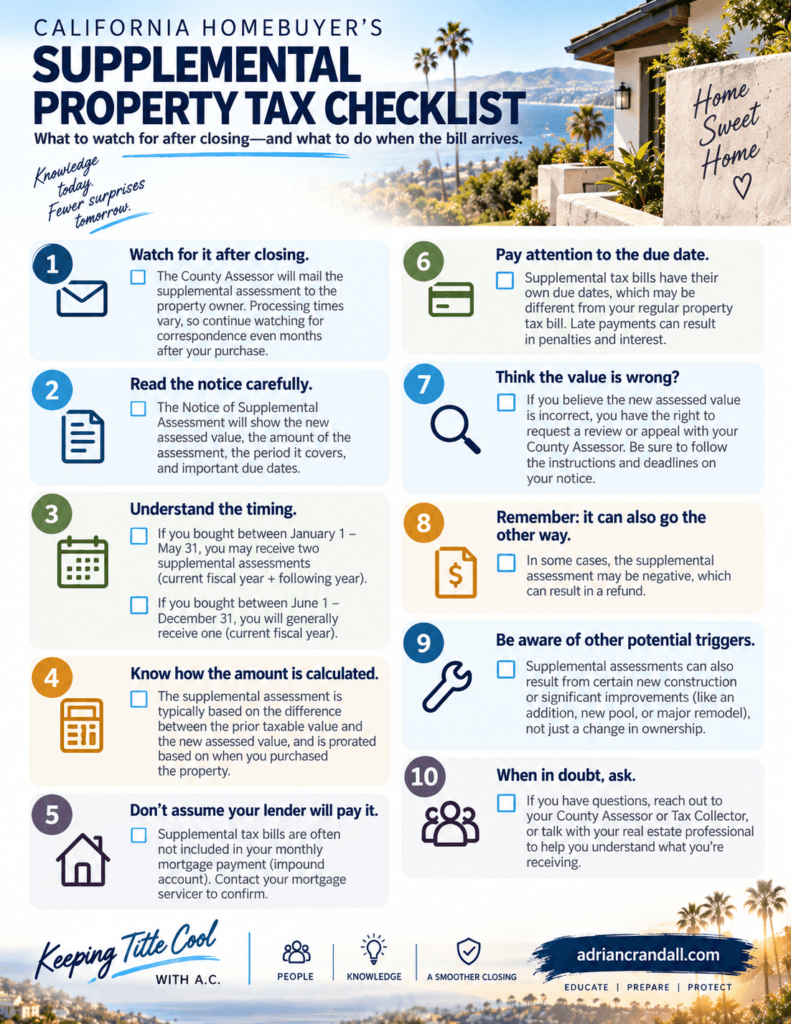
Realtors: Feel free to save this and share it with your buyers.
California Homebuyer’s Supplemental Property Tax Checklist
Buying a home comes with enough surprises. A supplemental property tax bill doesn’t need to be one of them.
I put together this simple one-page checklist to help California homeowners know what to watch for after closing, what to do when a supplemental assessment arrives, and a few things you definitely don’t want to assume.
This is also why I like looking at the whole picture
Supplemental taxes aren't a title insurance issue.
But after spending more than two decades in this business, I've learned that real estate problems rarely stay inside the neat little category we assign them.
A tax question can uncover a transfer issue.
A transfer can lead us to a trust.
A trust can reveal a vesting problem.
And a vesting problem that would have taken five minutes to identify before listing can suddenly become a much bigger deal when there's a buyer, a loan contingency and a closing date attached to it.
That's one reason I've become such a believer in reviewing title before the property goes into escrow.
Sometimes everything looks exactly as expected.
Great.
Other times we find something worth addressing while there's still plenty of time to address it.
The next time that frantic phone call comes in...
"Isn't the seller supposed to pay this?"
"Why is the bill so high?"
"Didn't we already pay the taxes?"
"Did somebody screw something up?"
Probably not.
Take a look at the property's previous assessed value.
Look at the new assessed value.
Look at when the buyer acquired the property.
And suddenly that scary-looking bill may make a whole lot more sense.
That's really what supplemental property taxes are about.
The county is catching the property's taxable value up with a change that already happened.
And once you understand that, the bill becomes a lot less mysterious.
Have a Property You're Getting Ready to List?
Some of the easiest title problems to solve are the ones we find before there's an escrow and a closing date attached to them.
I help my Realtor partners take an early look at ownership, vesting and potential title concerns before the listing goes live.
If you've got a property you're preparing to list—or something in the ownership history doesn't quite make sense—send it my way.

ABOUT THE AUTHOR
About Adrian Crandall
Senior Sales Executive | Corinthian Title Company
Real estate is full of moving parts—and the best decisions happen when someone helps connect the dots.
For more than 25 years, I’ve helped Southern California Realtors, lenders, escrow professionals, attorneys, investors and homeowners navigate title issues, housing policy, market trends and the hidden details that can delay a closing.
Through The AC Current and my Connecting the Dots series, my goal is to help real estate professionals stay informed, protect their clients and remain one step ahead.
Questions about title, vesting, probate, fraud prevention or a transaction? I’m always happy to be a resource.

Continue Connecting the Dots
More practical insight on title, housing policy, fraud prevention and Southern California real estate.



Stay Ahead of Southern California Real Estate
Each month, The AC Current delivers practical insight on market conditions, title issues, housing policy, fraud prevention, property taxes, probate and trust transactions.
Get The AC CurrentHelping Southern California real estate professionals connect the dots before they become closing-day surprises.
Keeping Title Cool with AC
This article is for general educational purposes and isn't tax or legal advice. Property-tax consequences depend on the circumstances of the individual property and transaction. Questions about a specific assessment should be directed to the applicable County Assessor or Tax Collector and, when appropriate, a qualified tax or legal professional.